I can’t stress forcefully enough how important the program:
The Weight of the Nation on HBO is. If you’re at all interested in learning about this issue, you need to watch this.
Category: The Human Body

Butter is Healthy: 5 Fat-free Food Lies that Made You a Butter-hater! | Nick Tumminello Hybrid Strength Training & Conditioning | Ft.Lauderdale Personal Trainer | Sports Performance & Bodybuilding
Results Orientated Training: the novice in the gym
There are many variables for a beginner to think through when deciding how to start a training program in a gym setting.
The first thing a beginner needs to do (in reality, everyone needs to do this) is decide on a clear idea of what they want to accomplish. Need to lose weight? Build a little muscle? Are you training for something specific, like a New Years resolution to run the NYC Marathon this year? Have you decided to take up a sport or activity like tennis or cycling? All of these considerations need to be taken into account if you intend on actually accomplishing anything in a reasonable amount of time.
For the teenager and young adult, it tends to be mostly about aesthetics and social mingling…wanting to look better and meet people. For the 30’s-50’s somethings it tends to be some combination of aesthetics, mingling, specific training for a new hobby like tennis, and physical health. And once we hit the 60+ category, health tends to take paramountcy, though aesthetics almost always remain in the background. Humans never seem to stop wanting to look better… Keep in mind that there is constant debate among “experts” as to proper protocols and where to focus your beginning efforts. The main thing to remember is that as a beginner you need to develop a foundation of general fitness, as I’m assuming you’re starting from scratch, out of shape, and in a state of complete “de-conditioning”. That means you need to develop a baseline of aerobic fitness (think endurance), and musculoskeletal strength and coordination.
Many trainers will argue that you should start on exercise bikes or elliptical trainers and weight lifting machines, as these pose the lowest risk of accidental injury. I cannot agree with the latter. Weight lifting machines are important tools, but they do nothing to train foundational core coordination among all the normal musculoskeletal interactions that occur in real life movements. They are safer to do in the gym (from the health club’s liability perspective), but many experts (myself included) would argue that learning and depending on machines in the beginning leaves you more vulnerable to injury in real world situations because you don’t learn how to coordinate you body movements and your muscular system when you need to do some actual pushing or pulling. If you don’t know what your doing, hire a good trainer for a few lessons. It doesn’t have to be a long-term commitment if your goal is to learn how to do a few exercises correctly. If you make it a priority, almost anyone can afford 3 or 4 hours of proper instruction.
Also, if you have any pre-existing medical conditions or are starting out in your 40’s or older you should get yourself a good medical check up first. So let me take you through some exercise recommendations for the novice. Commit to 45 minutes/day, 4 times a week. And Don’t tell me you can’t fit that in, cause my bullshit detector will go off. It doesn’t matter if you’re tired after work, or a have a little muscular soreness from a previous workout at this level. Just show up and do the best you can. Any four days will do. Stick to this order. Follow this routine for 4-6 weeks. Don’t get fancy. Don’t improvise. And make sure you eat properly with quality proteins, carbs and unsaturated fats. If you’re trying to lose fat weight, cut down on portion sizes. If you’re trying to build and gain muscle weight, add 1 or two high quality small meals to your day. That’s it. No magic formulas.
- Day one: bike or elliptical for 45 minutes. At level one, get your rpm (bike) or strides per minute (spm; elliptical) to about 80. Stay there for 10 minutes, then gradually begin increasing the level of difficulty by one, every 60-120 seconds (resistance or level) while maintaining a steady 80 rpm/spm. When you start huffing and puffing in order to continue, reduce your resistance down to a more comfortable level (not necessarily all the way down to 1 again) until your breathing becomes almost comfortable and your legs stop burning. Then repeat the process. Do this as many times as you can fit in for 30 minutes, then spend the last 5 minutes cooling down at level 1 at a slower speed. Done. Please read my blog posts on intensity, before starting this workout, here, and also here.


- Day two: Hit the weights. Start with Dumbbell Squats. You won’t know how heavy to go because you’re a beginner, so do a warm up set of 10 reps and see how hard it is to finish. If it feels less than a moderately intense effort; 7/10 on a ten point scale; then grab a set of light dumbbells and try again after resting 60-90 seconds. Keep trying until you determine that correct starting weights to use. Then do 3 sets of 10 reps with 60-90 seconds rest between each set. If you don’t know proper form, find a bench or low medium platform and sit on the edge of it while holding your weights. sit with good posture, then stand up strongly, slowly returning to the sitting position on the edge, without relaxing completely, and repeat. You are doing a “box” squat and all you need to do is remove the “box” when you get used to the movement pattern.


Push ups come next. Do a warm up set of 6-10 reps, rest for 60-90 seconds, then try to complete 3 more sets, 10 reps (or as many as you can finish if you can’t finish 10) each, with 60-90 seconds rest in between each set. Push ups can be done modified (on knees) if proper form cannot be maintained.


Next up are Lat Pulls . Since a 1st timer won’t know how much weight they can pull, the first set is an experiment. If you’re a male, try loading 50% of your body weight; if female try 30%. Attempt to complete 10 reps. If you cannot, make it slightly easier and try again after resting 90 seconds. If you completed 10 reps, and could have continued to do more, make it slightly harder, so that 10 reps becomes a real challenge (see this link on intensity). Do three fairly intense sets (7/10 perceived exertion), 10 reps each.


Now it’s time for dumbbell shoulder presses. Like all the others, you first need to determine how heavy your dumbbells need to be. The same intensity rules apply. If you’re female, grab a pair of 7.5 or 8 lb. dumbbells, a male should grab a pair of 10-15 lb. dumbbells. Try to do 10 reps. match the weight and the reps to the desired 7/10 intensity, and make any weight adjustments (up or down) you need to in order to get the proper workout. complete 3 sets, 10 reps each, once the correct weight has been determined. This exercise can be done seated or standing, but avoid supporting you back against anything, if possible. Doing it without back support will enhance abdominal conditioning as well as the other associated muscles of the core.


That is the whole weight lifting workout. Every major muscle of your body has been stimulated to adapt and get stronger. Once you’ve really learned it it won’t take more than 30 minutes to complete. If you have energy left at the end, hop on an elliptical, bike, or treadmill and move at a moderate pace for an additional 15 minutes to get a little extra calorie burn and endurance training.
- Day three repeats day 1
- Day 4 repeats day two
Always remember to follow the intensity rules I’ve laid out in my previous blog posts (linked above, and here, here and here), for both weight training and cardio/aerobics training during the 4-6 weeks you will follow this beginner routine.
Share this:

Developing a bullshit detector
This blog post has nothing to do with exercise and fitness, directly, but has everything to do with critical thinking, the nature of pseudoscience (and that pervades my industry), and how easily under and mis-educated people can be fooled into believing almost anything.
Read it, even if you believe, and think about why you believe so much that you know can’t possibly be true.
Share this:
Why Whole Milk is the Healthiest Choice | Care2 Healthy Living
Why Whole Milk is the Healthiest Choice | Care2 Healthy Living.
Just thought you should get another opinion (one I share).
Share this:
Leg press: yay or nay
The fitness industry is a cross current of trends, scams, and classicists who stick to tried and true methods. The “experts” are constantly re-evaluating what exercises you should, and shouldn’t do, labeling the “bad” ones as non-functional and contraindicated.
It’s almost always bull. Here’s a great posting from a great fitness educator, about the leg press machine:
http://www.t-nation.com/free_online_article/most_recent/is_the_leg_press_worthless
Share this:
Results Oriented (Purposeful) Training
Over the years I’ve been asked to train people for almost every conceivable reason, but in general, most seem to fall into the following categories. I plan on spending the next few weeks writing a post/week about each of the following topics with sample routines, that can be followed by those of you without access to me. In the near future, I hope to be able to offer enhanced services, including personal, customized training routines for a nominal fee to individuals who are geographically, or otherwise incapable, of meeting with me in person. Until then, the sample routines that will be posted in the next few weeks can be used and adapted as you all see fit. Keep in mind, that you need to make sure you know how to perform each exercise movement properly. The site ExRx is an excellent resource and has free to view video of most common exercises being performed properly.
The general main categories, and sub categories, as I see it:
1) General health and fitness for the sedentary person: novice
-
Youth
-
Young adult
-
Middle age
-
Senior
2) Total Body Conditioning: intermediate to advanced
-
Cardiovascular and musculoskeletal fitness
3) Body shaping: beginner to the advanced
-
Weight loss
-
Toning and Body Sculpting
-
Body building
4) Power and strength training: advanced
5) Athletic performance: advanced, sports specific and functional training
-
endurance
-
Strength
-
Speed
-
Agility
Feel free to comment on the categories, and let me know if you feel I’ve left any out, or why you might not fit into any of the above. If I agree, I’ll update my categories, or explain why I disagree. Keep reading!
Share this:

Running: Inside and Out

I want to talk about jogging and running, and the differences between outdoor training and treadmills.
When running outdoors their are environmental factors that come into play that affect exercise intensity. The obvious ones are wind resistance; you need to push your body through the air resistance when moving forward; and terrain variation, as no path is perfectly flat. On a treadmill, your body is not moving forward, so wind resistance is removed and need not be overcome, and the surface you’re running on is essentially flat. This is enough to cause treadmills to burn 5-10% fewer calories than outdoor running, though this can be compensated for by increasing the elevation 1°, while maintaining the same speed.
There are less obvious factors, however. For most runners, the form factor of the treadmill will alter the gate of the runner, forcing a more upright stance and altering the foot strike pattern, than would be optimal outdoors. An upright stance will change the way impact shock is distributed. This is compensated for by the treadmill with built in cushioning, but the upright posture can become habit and transfer into outdoor running where it can lead to a variety of injuries including shin splints, ankle, knee, hip and back pain.
Another factor is that research suggests treadmills over-report the amount of calories being burned by 20-25%. Factor in that treadmills are reputed to burn 5-10% fewer calories than outdoor running and the amount of calories you think your burning turns out to be significantly less.
I suspect, however, that even the 5-10% under-estimates the negative for treadmills. Many websites report that treadmills are essentially the same as outdoor running minus those environmental factors, but I disagree. I argue that the treadmill, being motorized, is inherently different than the proverbial hamster in a spinning wheel; the example most sited to explain why treadmills are mostly the same as outdoor running. The spinning wheel is not motorized, and the hamster must supply the energy to move it, even though the hamster is running in place. Another example is a person running on the deck of a cruise ship at sea. The cruise ship is moving, propelling the runner along regardless of their effort.
Both of these examples are erroneous. In the case of the hamster, the wheel will not move if the hamster doesn’t push it along, so while the hamster might remain stationary, it is pushing the wheel. The cruise ship example is even worse. A runner on deck would still be propelling their bodies forward, pushing through their hamstrings and glutes. On a treadmill, which is motorized, the treadmill is actually pushing your legs backward, reducing the use of your muscles to stabilization only, and not propulsion, as well.
Treadmills do have a place. Setting a fast pace can compensate for complacency. Inclement weather is no factor, and time of day is less an issue. Also, when you’re in a gym, you will exercise. All bets are off once you leave the premises.
My conclusion: when circumstances permit, walk jog, and run outdoors to maximize your exercise benefit. Leave the treadmill alone when possible.

Share this:

Exercise Science? part 2
Science is a rigorous, no-nonsense, discipline. A few months ago, a research team of physicists at the CERN laboratory in Switzerland reported that they had measured and recorded subatomic particles that traveled faster than the speed of light. This is the most revolutionary discovery in the history of modern physics. It completely destroys Albert Einstein’s theory of relativity and undermines the whole scientific consensus of how the universe works. The reaction of the scientific community was immediate and visceral: “hmm, that’s interesting. Lets double-check that.” “I wonder where they made their mistake? Lets check it out”. Even the CERN scientist who recorded this potentially revolutionary finding wondered: “I wondered what we did wrong?” Every real scientist would love to be the one that upend Einstein, just like Einstein overturned Newton. But no real scientist is going to base their reputation on 1 study that has not been independently verified multiple times. Not even if its their own study. That’s science. That’s integrity. That’s truth.
The world of exercise science is nothing but bogus hucksterism: verb [ with obj. ]promote or sell (something, typically a product of questionable value). Popular experts are dangerous people, selling opinions and personal preferences as facts, when their not trying to sell you a product they don’t even believe in. That’s the nature of the “fitness world”.
One of this blogs followers; Mia; asked me about another blog she read. I will not link to it, because it is terrible. The author, Kassem Hanson is a personal trainer, a disciple of Charles Poliquin (an expert I formerly admired until I read this garbage). The article talks about getting “skinny fat” and how certain exercise activities, like Spinning, can cause you to develop “cottage cheese thighs”.
I’m so tired of this. This Kassem Hanson, if his bio is to be believed, ought to be an expert that I could quote, not waste time refuting. He claims to have a BS in Exercise Science, BA Biochemistry and Molecular Biology – Cornell
BA Biology – Cornell. A google search seems to indicate he went to Cornell College, in Iowa, not the Ivy League University in NY. The fact that he intentionally leaves this vague indicates he wants you to assume the Ivy League connection. Not that there is anything wrong with the similarly named college. I don’t even have a degree in an exercise related field, which is why I would expect more from him. And I am disappointed.
Let me be clear. Not a single, reputable, scientifically based research study has shown spot reduction to be anything but a myth. The American Council of Exercise (ACE), The American College of Sports Medicine (ACSM), The National Strength and Conditioning Association (NSCA), The International Sports Science Association (ISSA), the National Association of Sports Medicine (NASM), and every other accredited personal training certifying body, as well as the National Institute of Health (NIH), all link to thousands of articles, research papers, and position papers giving the evidence against spot reduction of fat. The inverse is equally true. No activity can cause fat to specifically form in one area of the body over another, The simple fact is that body fat accumulation is mostly genetically determined. Again, the scientific evidence is overwhelming! Hanson, and apparently Poliquin, are basing their opinion on a lone Danish study from 2007 that was never peer-reviewed or duplicated independently. That such a study was done at all, and got published somewhere, doesn’t surprise me and was discussed in part one. That Hanson and Poliquin would tout this and base their entire training philosophy around a single dubious study goes more to show their personal exercise preferences and bias than their commitment to exercise truth.
They misinterpret what Spinning is, and even say that “indoor cycling” is a better choice because it incorporates anaerobic high intensity intervals. Uhhh, excuse me…Spinning is the original “indoor cycling program” and includes as part of its standard protocol anaerobic high intensity intervals, though there’s no guarantee in any program that the instructor truly understands or incorporates these principles, or that every participant follows those instructions.
He goes on to make other comments on the subject of things that will make you “skinny fat” mixing myths and facts indiscriminately, showing a tremendous lack of judgement. For instance, he says that eating a vegan diet will make you “skinny fat”. I know of at least 4 professional body builders who are Vegan, and I have friends who are vegan. The body builders look like body builders. And my friends run the gamut of fit, fat, “skinny fat” and powerful. No I don’t personally advocate the Vegan diet because it is it is way more complex to insure that the individual consumes adequate complete proteins, but properly done, it can be just as healthy as a meat inclusive diet, for most people. Please remember, that no diet is universally good for everyone.
Hanson claims scented candles will cause a man’s androgen levels to significantly drop. Where he gets this tidbit from I don’t know, but if it were true, then their must also be scents that would raise androgen levels. Where are those? Trust me when I say the FDA would have this as a controlled substance if it were true.
So watch the next tour d france, the track athletes running the mile, three-mile, or marathons in the next olympics, or the top 100 finishers of the next Iron Man Triathlon. Find the cottage cheese thighs. Find the “skinny fat” competitor. But also remember, you are not them. You don’t train as hard, you don’t eat as well, you don’t sleep as well, and you don’t dedicate your life to your training. That means you can’t compare you’re results, either.
What people like Hanson are doing is attacking a mode of training many people favor in the hope of getting these people to switch to a mode favored by Hanson (and other personal trainers). Since the activity is different, you may in fact start to see some positive change, but that has to do with the SAID principle, not to any inherent superiority of their training method. Once you start training with them, inertia is likely to keep you as long as you can afford it. Of course, with a trainer watching you, it’s much more likely that you will train more intensely. And that could lead to some improvement. And now they are getting your money, too.
Don’t expect unrealistic results that are greater than your commitment. and always ask for the research. Then ask for the independent, corroborating research. Stop being a sucker.
Share this:

Ice Baths
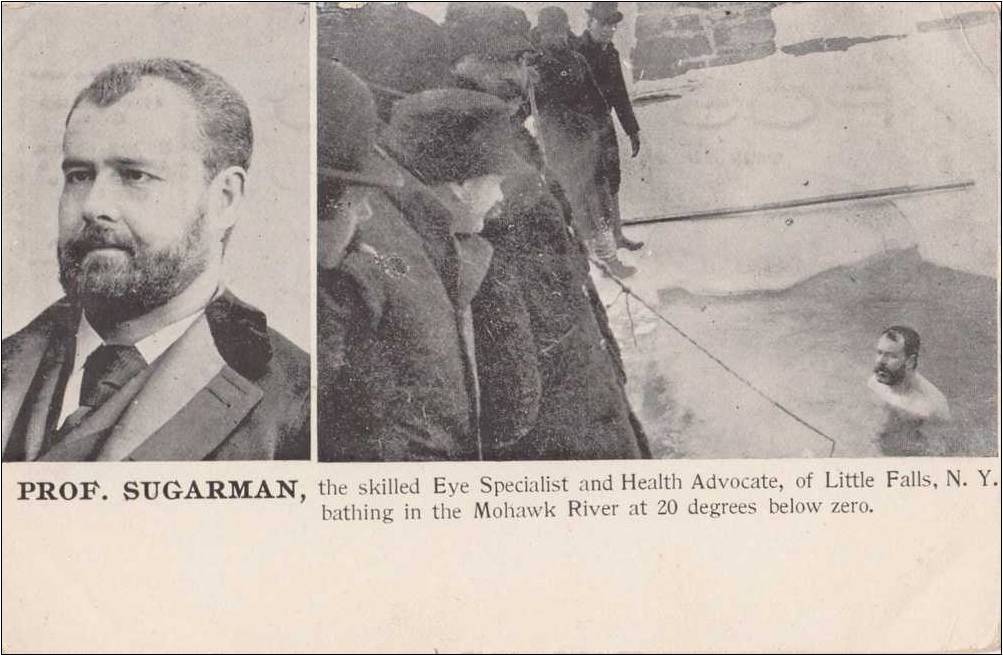

So what are we to make of the phenomenon of post exercise ice baths? Even a casual investigation of the therapy will reveal that there are no actual studies that support the effectiveness of the therapy as an aid to recovery. On the contrary, the few actual studies of its use in this regard are either inconclusive or show a negative impact. This is not the same thing as using it for the treatment of injuries, though I can’t imagine full body or partial body immersion as ever being necessary. Perhaps a runner suffering from chronic shin splints might immerse both legs up to her knees in an ice bath or bucket post race to deal with the pain and inflammation associated with that condition before it worsens post race, or to allow them to compete in the next event as close to full strength as possible, but for the average person, the very first letter of the RICE protocol says it all: REST! Being an athlete is not about being in great shape or being healthy! You must be in great shape to WIN. You must be as healthy as possible to WIN. BUT THE POINT IS TO COMPETE AND WIN! Athletes routinely sacrifice future health for the sake of their competitions. Are you willing to risk the future health of your knees in order to be able to squat 415 lb. in 3 months?
My take on the ice bath is this. Everyone is looking for magic. A successful athlete uses this technique and claims it is the source of her success (this is called anecdotal evidence: meaning personal opinion without any proof). Paula Radcliffe (image below right) is often credited with popularizing the practice by crediting her European long distance championship in 2002 to the use of ice baths. This reminds me of another piece of magic from the world of sports. In the late 90’s Mark McGwire was one of the great home run hitters and attributed his remarkable power to a readily available OTC supplement called DHA. It was touted as a steroid “precursor” that the body could use to make elevated levels of testosterone (increasing muscle mass and power). It’s popularity exploded in gyms and high school sports across the country. This was taken so seriously by baseball “authorities” that they actually banned its use. Of course, what McGwire didn’t tell the world was that he was actually taking steroids, too, and that maybe actual steroids had just a little to do with his herculean power. DHA, meanwhile, is still readily available at your local Vitamin Shop and GNC. And the FDA hasn’t seen fit to pull it off the market 20 years later.

What might ice baths do to actually help improve athletic performance? Well, there’s the placebo effect. You think something helps, so you unconsciously push yourself a little harder than you previously thought possible (though it was always possible). It probably increases the victims tolerance to pain and extreme discomfort (SAID principle), allowing the athlete to mentally push through their pain threshold allows them to push just a little harder than their competitors (no research to prove this. It is just my supposition; an uncertain belief). You can now site this on your own, and in a few years it will be repeated as a fact by hundreds of sources all linking back to each other and this blog in a vicious circle of fog and mis-information, that may turn out to be true, or false, if anyone ever deigns to do actual reproducible studies.
Here’s the Wikipedia link to ice baths: click this
Just remember, unless you’re a competitive athlete; i.e. someone who lives and dies their actual competitions; when you’re injured you rest your injuries as the first protocol of RICE. Even professional Athletes, in their off-season, rest.

 Fitnessgroan's Blog