Inactivity is a truly silent killer. Too many Americans, and others in the developed world, simply do not move enough to maintain minimal standards of health. There are many culprits, and no doubt the easiest one pundits will blame is probably video games. I take issue with that, however. In the 19th century politicians and social critics railed against the evils of too much reading; it will make you act out, unable to distinguish fantasy from reality, and make you lazy sitting around for hours every day. In the 20th century it was television. Now it’s video games. Every new mode of entertainment frightens, distresses, and annoys those too old to understand it. If it didn’t annoy the older generation, it probably wouldn’t be popular in the first place. Regardless, these excuses don’t hold water. Individuals can abuse anything, but the fact is we have created a society that does not privilege physical activity unless you happen to be physically gifted to begin with. Gym is usually one of the first things eliminated from budget strapped schools, right after the arts, rather than raise taxes in order to be able to continue offering these vital programs. No one wants their taxes raised, but then decry when their services are cut. Why do so many of us insist on believing in the magical free ride? Worried about corruption and waste? Grow up! it exists in every human endeavor. It exists in your own homes ever time a husband or wife holds back a little extra from a paycheck, or a child keeps the change when the are sent out on an errand, or a freaking credit card is used for any reason! If you can’t escape waste, fraud, and corruption in your own home, what magical world do you live in that allows you to believe it won’t exist in the public sector? Get over it. Put your money where it belongs, into the future for your children, and that future should include you living long and healthy enough to play with your grandchildren.
So now that I’ve given you my two cents, read this article published in the prestigious Lancet.
Everyone is looking for the magic routine or the magic exercise, as if there is some secret that will transform your body better, quicker, easier, than any other. Sorry. That doesn’t work. People always assume that the advice they can get from some super trainer of celebrities is going to work better than they could get from their neighborhood gym trainer. Uh-uh. The advice you get from any trainer is going to be the same crap shoot you’d get from any other trainer. You have no way of knowing if the advice is good or bad unless you have good knowledge to know better yourself, and the average gym goer simply doesn’t.
This brings me to one of my personal issues with training blogs, in general. Most of the blog posts out there (and I subscribe to more than a few) seem to focus on describing killer routines or Best Butt Busting exercises (or any other body part you might want to develop). They can’t all be the best, can they? This is sensationalism at it’s most idiotic.There is no magic and there are no shortcuts. There is knowledge and evidence based training, and there is bullshit. Every exercise is a tool, but not every tool is appropriate for every job.
The problem I have with these posts is that there seems to be an assumption that the reader will understand how to do these workouts and exercises properly, and be able to integrate them into their existing workouts effectively. Inevitably, someone writes in how following so and so’s advice led to a major knee, lower back or other musculoskeletal injury and that so and so doesn’t know what they’re talking about and is a horrible trainer. Most of my readers are not fitness professionals or professional athletes, and I have no way of knowing if any specific advice I give will be followed properly, but I will be held responsible by that person if anything goes wrong. It almost never seems to occur to these complainers that perhaps they did the exercises badly, or improperly implemented the advice. All the same, I fault the Fitness expert writing for not properly qualifying their advice. I also blame them for giving too much of this kind of advice. Every other post seems to tout this or that exercise as the best for a specific muscle group, and the posts in-between talk about this or that routine as being the greatest. As these bloggers and professional writers are far and away the most popular, I suppose I can’t totally condemn them.
That said, people still want to know: what is the best exercise routine a person can follow for overall fitness? So here it is, a routine that will absolutely get you in great shape if you do it fervently every other day till the day you die, assuming you follow all the rules of intensity that I’ve laid out innumerable times and you are otherwise physically healthy with no major pre-existing injuries:
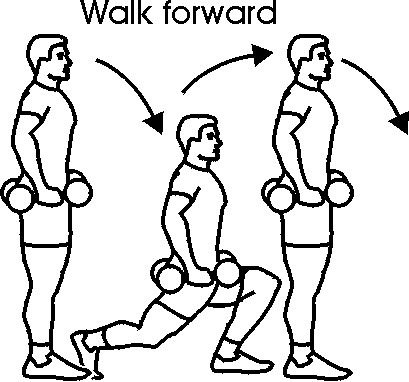
Walking Lunges with dumbbells: perform up to 7 sets, with rep ranges between 12 steps and 30 steps, so long as the last 3 steps of every set are exhausting.
Pull ups/Lat Pulldowns: perform up to 7 sets, with rep ranges between 6 and 15 reps, making sure the last rep of every set is almost impossible to complete.
A US Marine Doing Pull-ups. (Photo credit: Wikipedia)
Push Ups (toes or knees): perform up to 7 sets, as many reps as you can with good form on every set (even if it’s 50 reps on the 1st and 2 reps on the last).
English: an exercise of chest (Photo credit: Wikipedia)
Make sure you know how to do every exercise correctly, or get a trainer to show you. Just doing these three exercises, in the routine I’ve laid out for you, is the most perfect and magical workout ever devised by mortal man. Do this every other day, throw in cardio on in-between days. Don’t forget to eat like a champion athlete and sleep like a 10-year-old, and you will get into unbelievably great shape practically overnight (ok, in 6-12 months).
The intermediate exerciser has learned at least 3 of the 5 important things in order to progress to this level, and it shows. Most serious health club exercisers fall into this category, though my personal observation is that no more than 20% of gym members ever make it to this level, and instead remain novices despite the amount of time they spend in the gym going from one activity to another. The Intermediate Exerciserhas lost significant body fat and has gained some real muscle, either in the form of size and bulk or muscular definition, or both, depending on their goal. The 5 critical things that the intermediate exerciser understands and conforms to:
Consistency
Intensity
broad knowledge of muscle function
Nutrition
Rest
Lets take these 5 in order.
Consistency is just what it says. You are committed to your workouts and have a schedule you will not deviate from when possible. You have set aside a certain number of days; typically 4-6; and a set amount of time; typically 60-90 minutes; and you train. This isn’t something you try to fit into your day. It is one of your highest priorities that you work the rest of your day around. When doing cardiovascular/aerobic training you have a protocol you follow and stick to it. When weight lifting, you typically follow some version of a split routine for your body parts, the classic example being Chest/Shoulders/Triceps on day one, Back/Biceps on day two, and Lower Body on day three. Then repeating that pattern for a six-day workout with one day off for complete rest. You will stick to this pattern till doomsday comes or until you change goals. Additionally, you understand the importance of your exercise routine; variation is not your friend in this regard.You need to stick to a routine that you can make comparative assessments on. That means the same, or extremely similar, exercises for each body part every time you train that body part. If your goal is to be the best marathon runner you can be, you don’t spend hours a week ridding a lifecycle or taking spin classes; you run miles, period! If your goal is to improve your overall muscular strength, or build muscle, you pick your exercises and do them repetitively for months on end, the only variables being that you will continuously push yourself to lift heavier weights every week or even every workout!
Intensityis all about understanding your goal. It is the most important factor that will determine whether you actually achieve any measurable progress, whether it’s increasing you distance on a bike ride, speed in the 400 meter run, or your 1 rep max doing an olympic bench press. Trying to lose weight requires a certain intensity. Building muscle requires its own level of intensity. Improving athletic performance…has its own special intensity demands. Not understanding what intensity you need to achieve will undermine everything you try to accomplish. Too much high intensity training will undermine a marathoner, and too little will be futile for the sprinter or weight lifter. If you haven’t read my posts on intensity, or want to refresh your memory click here and here.
Broad knowledge of muscle function means you really understand how all the major skeletal muscles move and work, and know a pretty broad range of exercises for each of them. It’s like having a large vocabulary of exercises to draw on. Since you also understand how the muscles work, it allows you to choose complimentary exercises when doing multiples per body part. You understand why you might want to do pec flys after olympic bench press, not before, or why doing lat pull downs after pull ups might be redundant, so doing dumbbell rows is the better choice to follow-up with in most cases. (Yes, there might be a valid reason to do both pull ups and lat pull downs in the same workout, but that wouldn’t be the most common combo or even the norm). You understand which exercises will enhance your athletic activities or hinder them, and train accordingly.
Nutritionis simply the understanding that what you consume is both the fuel that moves you and the building blocks of what your body is made of. The cliche´ “You are what you eat” is precisely true. Trying to build a powerful body on a diet of McDonald’s, Pepsi, and Twizzlers, is akin to building a battleship hull out of corroded iron. If you can’t get serious about what you eat, get out of the gym. I follow the 80/20 rule. I eat extremely healthful 80% of the time, and don’t worry about the other 20%. The less fit you start, the more dedicated yo have to be. If you’re very overweight and extremely unfit, you need to follow the 100% rule; all healthy, all the time. Period. Don’t cry about fairness, it won’t help. As a fuel, the foods you eat (solid and liquid) all have their specific purposes, and understanding them is critical. Even the most wholesome foods misused can have a counterproductive effect if not properly applied. Every serious endurance athlete understands the importance of carb loading; where you consume vast quantities of mostly simple carbohydrates like pasta the day before the big race. Serious marathoners are extremely lean, carrying minimal body fat (reserve energy stores) to breakdown as the miles accumulate into the high teens. So they manipulate their diets to maximize the available energy on race day. If you don’t run over 100 miles a week, don’t eat like a marathoner, cause you’ll get fatter than a walrus in a well stocked zoo. 20 years ago everyone said eat all the pasta you want because that’s what skinny marathoners eat, now we say avoid all pasta! Both are stupid statements. The question is: how will eating all this pasta help me in my life’s pursuits! If it won’t, don’t eat so much. The strength athlete eats large amounts of protein because protein is what muscles are made of, and when trying to build bigger and stronger muscles your body needs these proteins to build your muscles into larger ones. If you don’t consume enough protein, your muscles simply cannot get bigger or stronger. It’s not magic. If you’re lifting weights with the correct intensity and not able to get stronger or bigger, it’s a pretty good bet you’re not eating enough protein. The most misunderstood food constituent is fat. Fat is neither good or bad. It is a very dense energy source and a necessary nutrient for a whole host of metabolic processes. Fat isn’t the villain in America’s obesity epidemic; people are the enemy of themselves. When it comes to weight control, what matters at the end of the day is how many calories you ate compared to how many you burned. The average 30-year-old woman burns around 1500 calories per day just staying alive. If her diet consisted of 720 calories of fat (80 g of fat; 1 g = 9 cal) and 600 calories split evenly between protein (60 g; 4 cal/gram) and carbohydrate (60 g; 4 cal/gram) she would be following a successful weight loss program! In 20 days, she will have lost 1 lb. Not the fastest program, but if we replaced all those fat calories (720) with proteins and/or carbs, her weight loss would be exactly the same. Fat doesn’t make you fat…eating too many total calories makes you fat and you not understanding your food makes you fat. Now lets not get into a debate of whether eating so much fat in a day is healthy in other ways, because that’s missing the point I’m trying to make.
Restis so basic and obvious that it’s absurd how little attention avid gym goers give to it, but the intermediate exerciser understands that the end of the workout is only the end of the beginning of the exercise process. For the endurance enthusiast or the strength training enthusiast sleep is understood as the point in your day when all the hard work is actually transformed into results. The results of your training and proper nutrition can only be realized after a good nights sleep. While asleep your body makes all the cellular and physiological adaptations to your body in response to what you did that day. If you don’t get good sleep, your improvement can be slowed, stalled completely, or even reversed into a negative (over training syndrome), when instead of performance improvements you see lower energy levels, lower endurance, lower strength, and more frequent injuries. Imagine if NFL players were required to play 3 days a week, or if every MLB team were only allowed to have 1 pitcher who had to pitch every single game. That’s obviously ridiculous because these athletes have a hard time going thru a regular season injury free. In my hypothetical, they’d be lucky to last a month before being permanently impaired. To a lesser intensity, that’s exactly what the majority of gym goers are doing to themselves, going from class to class to class, three to five hours a day, 5, 6, 7 days a week. Ms. Intermediate understands that if she gauges her intensity correctly she will be done with her workout in 45-90 minutes (unless a marathoner or other ultra endurance athlete) and she will eat properly and get her 7-9 hours of sleep.
In conclusion, you must master and implement at least 3 of these factors in order to achieve any real results, and 4 of them to be able to move on to the next level. Think about what I’ve said. If you’ve been spinning your wheels in beginner land for more than 6 months, you need to implement the steps above to get to the next level. Good luck.
Nutrition is a touchy subject. People are either oblivious to its importance or they take on an almost religious reverence towards whatever philosophy they believe in. My own daughter was a 90% vegetarian, but was forced to add red meat into her diet because she developed dangerous vitamin deficiencies. No one diet is going to be able to satisfy the optimal needs for the entire spectrum of human need. Below is a link to a good NY Times article; a thoughtful discussion by respected clinical and sports nutritionists. Enjoy
There are many variables for a beginner to think through when deciding how to start a training program in a gym setting.
The first thing a beginner needs to do (in reality, everyone needs to do this) is decide on a clear idea of what they want to accomplish. Need to lose weight? Build a little muscle? Are you training for something specific, like a New Years resolution to run the NYC Marathon this year? Have you decided to take up a sport or activity like tennis or cycling? All of these considerations need to be taken into account if you intend on actually accomplishing anything in a reasonable amount of time.
For the teenager and young adult, it tends to be mostly about aesthetics and social mingling…wanting to look better and meet people. For the 30’s-50’s somethings it tends to be some combination of aesthetics, mingling, specific training for a new hobby like tennis, and physical health. And once we hit the 60+ category, health tends to take paramountcy, though aesthetics almost always remain in the background. Humans never seem to stop wanting to look better… Keep in mind that there is constant debate among “experts” as to proper protocols and where to focus your beginning efforts. The main thing to remember is that as a beginner you need to develop a foundation of general fitness, as I’m assuming you’re starting from scratch, out of shape, and in a state of complete “de-conditioning”. That means you need to develop a baseline of aerobic fitness (think endurance), and musculoskeletal strength and coordination.
Many trainers will argue that you should start on exercise bikes or elliptical trainers and weight lifting machines, as these pose the lowest risk of accidental injury. I cannot agree with the latter. Weight lifting machines are important tools, but they do nothing to train foundational core coordination among all the normal musculoskeletal interactions that occur in real life movements. They are safer to do in the gym (from the health club’s liability perspective), but many experts (myself included) would argue that learning and depending on machines in the beginning leaves you more vulnerable to injury in real world situations because you don’t learn how to coordinate you body movements and your muscular system when you need to do some actual pushing or pulling. If you don’t know what your doing, hire a good trainer for a few lessons. It doesn’t have to be a long-term commitment if your goal is to learn how to do a few exercises correctly. If you make it a priority, almost anyone can afford 3 or 4 hours of proper instruction.
Also, if you have any pre-existing medical conditions or are starting out in your 40’s or older you should get yourself a good medical check up first. So let me take you through some exercise recommendations for the novice. Commit to 45 minutes/day, 4 times a week. And Don’t tell me you can’t fit that in, cause my bullshit detector will go off. It doesn’t matter if you’re tired after work, or a have a little muscular soreness from a previous workout at this level. Just show up and do the best you can. Any four days will do. Stick to this order. Follow this routine for 4-6 weeks. Don’t get fancy. Don’t improvise. And make sure you eat properly with quality proteins, carbs and unsaturated fats. If you’re trying to lose fat weight, cut down on portion sizes. If you’re trying to build and gain muscle weight, add 1 or two high quality small meals to your day. That’s it. No magic formulas.
Day one: bike or elliptical for 45 minutes. At level one, get your rpm (bike) or strides per minute (spm; elliptical) to about 80. Stay there for 10 minutes, then gradually begin increasing the level of difficulty by one, every 60-120 seconds (resistance or level) while maintaining a steady 80 rpm/spm. When you start huffing and puffing in order to continue, reduce your resistance down to a more comfortable level (not necessarily all the way down to 1 again) until your breathing becomes almost comfortable and your legs stop burning. Then repeat the process. Do this as many times as you can fit in for 30 minutes, then spend the last 5 minutes cooling down at level 1 at a slower speed. Done. Please read my blog posts on intensity, before starting this workout, here, and also here.
Animated cartoon on a exercise bike, Svenska: Animerad streckgubbe på en motionscykel. (Photo credit: Wikipedia)
Day two: Hit the weights. Start with Dumbbell Squats. You won’t know how heavy to go because you’re a beginner, so do a warm up set of 10 reps and see how hard it is to finish. If it feels less than a moderately intense effort; 7/10 on a ten point scale; then grab a set of light dumbbells and try again after resting 60-90 seconds. Keep trying until you determine that correct starting weights to use. Then do 3 sets of 10 reps with 60-90 seconds rest between each set. If you don’t know proper form, find a bench or low medium platform and sit on the edge of it while holding your weights. sit with good posture, then stand up strongly, slowly returning to the sitting position on the edge, without relaxing completely, and repeat. You are doing a “box” squat and all you need to do is remove the “box” when you get used to the movement pattern.
an exercise of thigh (Photo credit: Wikipedia)an exercise of thigh (Photo credit: Wikipedia)
Push ups come next. Do a warm up set of 6-10 reps, rest for 60-90 seconds, then try to complete 3 more sets, 10 reps (or as many as you can finish if you can’t finish 10) each, with 60-90 seconds rest in between each set. Push ups can be done modified (on knees) if proper form cannot be maintained.
an exercise of chest (Photo credit: Wikipedia
Next up are Lat Pulls . Since a 1st timer won’t know how much weight they can pull, the first set is an experiment. If you’re a male, try loading 50% of your body weight; if female try 30%. Attempt to complete 10 reps. If you cannot, make it slightly easier and try again after resting 90 seconds. If you completed 10 reps, and could have continued to do more, make it slightly harder, so that 10 reps becomes a real challenge (see this link on intensity). Do three fairly intense sets (7/10 perceived exertion), 10 reps each.
an exercise of upper back (Photo credit: Wikipedia)an exercise of upper back (Photo credit: Wikipedia)
Now it’s time for dumbbell shoulder presses. Like all the others, you first need to determine how heavy your dumbbells need to be. The same intensity rules apply. If you’re female, grab a pair of 7.5 or 8 lb. dumbbells, a male should grab a pair of 10-15 lb. dumbbells. Try to do 10 reps. match the weight and the reps to the desired 7/10 intensity, and make any weight adjustments (up or down) you need to in order to get the proper workout. complete 3 sets, 10 reps each, once the correct weight has been determined. This exercise can be done seated or standing, but avoid supporting you back against anything, if possible. Doing it without back support will enhance abdominal conditioning as well as the other associated muscles of the core.
an exercise of shoulders (Photo credit: Wikipedia)an exercise of shoulders (Photo credit: Wikipedia
That is the whole weight lifting workout. Every major muscle of your body has been stimulated to adapt and get stronger. Once you’ve really learned it it won’t take more than 30 minutes to complete. If you have energy left at the end, hop on an elliptical, bike, or treadmill and move at a moderate pace for an additional 15 minutes to get a little extra calorie burn and endurance training.
Day three repeats day 1
Day 4 repeats day two
Always remember to follow the intensity rules I’ve laid out in my previous blog posts (linked above, and here, here and here), for both weight training and cardio/aerobics training during the 4-6 weeks you will follow this beginner routine.
Nutritionists have had a model for how refined sugars and simple carbs negatively impact the human body. In a nutshell, it works like this:
I eat or drink a high sugar food product (candy, soda, pasta, breads; your body thinks they’re all the same). These things are already in their most broken down state and are ready for immediate absorption. Body releases a lot of insulin, which sucks up the sugar and causes blood sugar to temporarily soar (momentarily boosting energy) then catastrophically crash since it just as easily gets stored (as fat) if you don’t use it right away.
Image via Wikipedia
When the burst of energy ends, your brain wants to get the energy back and tells you your hungry, again. This model still works, but it’s an incomplete picture, and the truth appears to be even more insidious.
Our friend Thane shared this link which details the neurobiological mechanisms that underly the classic model I sketched above. It sheds light on why it’s so hard to break this cycle, and tells us how to more effectively deal with the problem. What I find most amusing is the fact that old medical advice from the 50’s and 60’s, on how to manage blood sugar levels using a chart called the glycemic index, came to these same conclusions long ago.
The article is still fascinating if your into science and health and fitness, so check it out here.
Another great NY Times health article on the almost un-intended benefits of exercise: improved brain function as you age. Read it here: http://nyti.ms/vj3Epu
Stretching (see part 1)has no inherent physiological health benefits. Should anyone stretch? Why stretch at all? As my brother, an auto mechanic might say, “…there’s a tool for every job, pick the right one”. Stretching is a a tool that can enhance athletic performance and exercise, and impede athletic performance and exercise. As a tool, it can help alleviate cramps and a sense of physical discomfort, but overused can lead to excessive joint laxity and increased risk of injury. It is a tool to be used specifically, not blindly. It is not inherently healthier to be more flexible. This isn’t about faith or dogma. Why and how we are stretching is the question.
It will not prevent or reduce the risk of getting muscle cramps if done before a workout.
It can increase the risk of injury due to excessive joint laxity. The more flexible a joint is, the more inherently unstable it is, leaving the joint vulnerable to dislocation and tendon/ligament injury).
It might decrease sport specific performance (extremely elongated muscle will have reduced inherent muscular tension; tension which aids in the contractile response. All muscle fibers have an automatic contract reflex when the brain senses the muscle has reached a certain length/stretch. This reflex causes the muscle to contract suddenly, and can aid in activities that require explosive movements.
Pros:
It can help correct or minimize musculoskeletal pain and discomfort caused by muscular tightness and imbalance (lower back, hip, knee, ankle).
It can reduce the risk of cramping, post exercise and athletic activity.
It might help in alleviating active cramps.
It can enhance the performance of specific activities prior to, and after, like:
Ballet
Gymnastics
Yoga
Weight lifting, Aerobics, and Athletics: each form has its own specific flexibility and range of motion (ROM) requirements where overly tight muscles could impede performance.
Martial arts
There are different types of stretching techniques that are popular. They each have benefits when applied appropriately.
Static Stretching refers to the technique of lengthening a muscle to the point of mild discomfort and holding that position for 30-90 seconds. In my experience this is the least functional of the prescribed methods. Animals, and their associated joints move, and in most real world situations you wouldn’t bend down to touch your toes and not move for 90 seconds. It might be more efficacious when dealing with certain injuries and post exercise to use this technique, but modern research is moving against this technique. Traditional stretching is the most common form, with PNF(proprioceptive neuromuscular facilitation) being an advanced technique that has demonstrated quicker, and greater results.
Dynamic Stretching refers to the technique of moving a joint through a range of motion into a stretch, and then back out of the stretch. This is done repetitively and rhythmically in a way that facilitates flexibility for a specific activity, without short circuiting the natural contractile responses of the targeted muscle. It would apply to virtually any activity listed under pros, and would be most beneficial to perform before, during, and after the activity. An advanced technique would be AI (Active Isolated Stretching) advocated by the father/son team of Jim and Phil Wharton.
Ballistic Stretching refers to the method of bouncing, swinging, and flinging a limb or body part into a deep stretch and then letting the muscle bounce out of the stretch. This method should be avoided at all times and at all costs! This method can actually cause the targeted muscles to shorten and tighten more. It has no reported sport specific benefits that I’ve read.



 Fitnessgroan's Blog