The fitness world is a funny place to live. Very knowledgeable fitness experts will gladly tell the world the right, and wrong, ways to train. “Do this, never do that” kind of things.
The official term for movements and exercises that we recommend never doing is contraindicated. There are a lot of reasons an expert or the entire industry might declare something contraindicated, but the majority of the time it’s because the reasoning behind the exercise is outside the scope of knowledge of the expert or the expert and the industry at large doubts our ability to perform the exercise correctly, and the risk of injury in that case out ways the potential benefit of doing it right.
There are a lot of reasons people have a difficult time performing certain exercises with proper form, but the 4 most common reasons are:
1) we don’t pay attention when being taught
2) our muscles are so tight and out of balance we can’t move thru the range of motion properly
3) our muscles are moderately tight and inhibit our movement so that when we attempt to attain a certain range of motion; that was arbitrarily set based on a non existent norm; our form breaks down
4) we weren’t taught properly to begin with; either the trainer rushed through the exercise instruction or didn’t know how to do it properly themselves.
Regardless, remember that when you look at an illustration of how an exercise ought to be performed you are being shown an ideal, perfect situation, one that seldom exists and in our cases probably never can exist. Use the image as a guideline. Move as though you were attempting to mimic that image, and stop the movement at just before the point where you cannot maintain the proper form. This is true with weight lifting. This is true with yoga. Now read the article so you can improve your abilities to whatever degree is possible.
Thanks to reader Thane, again, for bringing a great piece to my attention (and yours, by extension).
Kudos to the NYT. As seems to be their pattern, they publish an outstanding piece following an embarrassingly bad one.
Below is a really GOOD article published in the NYT about the benefits of high intensity training (with some caveats) for older adults; 60+ years old up to 75! The same advice could be given to just about anyone, at any age. Intensity is king when it comes to physical training. And high intensity is relative to the current condition, and age, of the trainor. In other words, stop futzing around. Click the link below
There is something special about shoulders, that place them almost on par with breasts and butts for women, and pecs and biceps, for men. How we define nice shoulders may vary from person to person, but when you get down to it, it’s only a discussion of degrees. Shapely defined shoulders are attractive to most everyone, on everyone. It’s even a recurring female fashion trend to add shoulder padding in blouses and blazers.
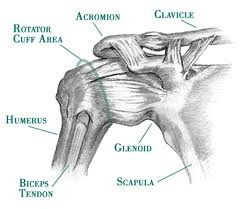
Some interesting facts about the shoulder. It is the most mobile joint in the the human body, able to move the most degrees in ever single plane of motion. The “shoulder girdle” is involved in almost every possible torso exercise. This creates the opportunity for a great variety of possible exercises, but this comes with increased ***joint laxity***, compared to your other joints, creating greater risk of injury do to accidental hyperextension leading to muscular and connective tissue damage. The fact of its extreme mobility puts it at the most risk of accidental injury, and it’s necessary involvement in all torso exercises put it at risk of over use injuries.
Click this for a detailed overview of the shoulder joint: shoulder anatomy, in detail
The number of possible shoulder exercises/movements can be overwhelming, and trying to do every possible variation in every possible movement pattern would be an all day, monotonous, and dangerous, mess.
Here’s a rundown of the most frequently used shoulder exercises seen in a typical health club:
1. Dumbbell Military Press (standing)
2. Dumbbell Seated shoulder press
3. Dumbbell Lateral raises
4. Dumbbell front raise
5. Dumbbell bent over reverse fly’s
6. Barbell Military Press (standing)
7. Smith machine seated shoulder press
8. Nautilus (or other manufacturer) shoulder press machine
9. Nautilus (or other) lateral raise machine
10. Pec Fly/**rear delt** machine
11. Cable front raise
12. Cable lateral raise
13. Cable rear deltoid
14. Cable overhead press
You can look all these up on the invaluable website: ExRx.net
And these are just the most common ones. I could probably expand this list for pages if I wanted, but I don’t want to and most of you don’t want me to, either. These are just deltoid specific exercises. Then there are all the other major muscle exercises of the torso that put tremendous stress of the deltoids. For example, all of the following chest exercises work the anterior (front) deltoid intensely:
*Push ups, Olympic bench press, dumbbell bench press, incline bench press, decline bench press, dumbbell pec fly, cable pec fly’s, machine pec fly*.
All of the next group work the posterior (rear) deltoids and other muscles of the back shoulder girdle:
*Pull ups, Lat pull downs, long pulls, dumbbell bent over rows, barbell rows, cable rows, machine rows (nautilus or other) *.
With so many exercises hitting anterior and posterior deltoids heavily, one aught to wonder why some exercisers insist on spending so much time on trying to target those areas specifically. For the vast majority of gym goers lifting weights, overhead presses and lateral raises are all that are needed to develop well shaped and strong shoulders, as all the other exercises you should be doing for your upper body are taking care of the other two regions of the deltoids.
Given the over importance shoulder training seems to take on with serious weight lifters of both sexes, it shouldn’t be surprising that shoulder pain is one of the three most frequently sited gym associated injuries (lower back and knees being the other two).
If you’re not a competitive bodybuilder, or someone who wants to look like one, my advice is to cut down on shoulder training, and focus on lateral raise and/or shoulder press, while making sure that your chest (pushing exercise=anterior deltoid) and back (pulling exercises=posterior deltoid) exercises are truly challenging.
Of course, always follow strict good form. The first really bad rep performed should be the last rep of the set.
People always ask me what training style I follow. My answer usually perplexes them…
“I’m not a yeller”, I might say, (my spinning adherents might disagree, but that’s a different environment).
“Whatever seems to suit your needs, if it’s within me”, is another common answer I give.
Or, “observational and fact based training”.
None of these answers is satisfying for most prospective clients. That want to know what kind of “system” I adhere to.
One certifying body; NASM (national academy of sports medicine) has actually created a rigid model they expect all trainers to conform to, and all trainees to accept. They are ridiculous, and their concept is ludicrous. That’s fodder for another posting.
Nick Tumonello, a fitness educator, has posted on his blog 7 tips from Bruce Lee that will make you a better trainer. These words of wisdom from the late martial arts master cut to the chase of my philosophical beliefs when it comes to training, and most other aspects of daily life. Click this to read more.
It’s easy to get complacent going into the holiday season. Distractions, food, family, friends, and parties all conspire to encourage us to put off making real fitness gains until the new year.
My challenge is this: let’s use the next 6 weeks to get into the best shape of our lives. Here’s my advice. First, if you need to lose weight, don’t focus on denial. Focus on content. Whatever you eat, enjoy. But only eat half of every meal. Only eat half of every desert. Only eat half of every snack. It’s not hard, at least it’s not if you believe you’re worth the effort it takes to pay attention to yourself.
Then follow these instructions regarding working out:
Identify your type:
Image via Wikipedia
Are you an aeroboholic; someone who loves cardio to the virtual exclusion of other activities, even though you know you need weights too?
Now that you’ve identified your exercise personality type do this. Commit to 4 days a week minimum.
If you are a aeroboholic by nature, switch to 3 weight trainingworkouts (not classes) and only do 1 cardio workout. If you can make it in more often, add 1 cardio, then 1 weight lifting. When you do your cardio, increase the intensity of your speed, elevation, and resistance, even if it decreases your duration a bit (keep 30 minutes as a bare minimum, however). When doing weight lifting, add an additional set to every exercise, and make that last set much more difficult than you are used too.
If you are a self identified aerobophobic you will, for the next 6 weeks, divide your workouts 50/50. Pick one aerobic activity that you dislike least (class or machine) and really push yourself hard. Continue to lift weights as normal twice/week. If you can add additional days, only add cardiovascular work, but don’t be afraid to do intense intervals. Sprinting can and will develop muscle.
In 6 weeks, both types will see dramatic improvement in terms of appearance and performance, when you eventually return to your normal routines.
I usually tell clients going away on vacation to take it easy, especially if it’s going to be an active trip with lots of walking and other physical activities.
This isn’t one of those trips. Visiting family for the holidays usually involves lots of sitting around, talking, catching up, and eating too much of everything including junk (is it just my family?)
I got to Phoenix on Saturday. Today, I finally got to a gym in the morning. LA Fitness. Big place, probably 3 or 4 times the size of NYSC in Forest Hills. Besides a large free weight section, a huge weight lifting machine section, 2 large cardio areas, a cycle room featuring Kaiser bikes, and a large aerobics studio. They also have 5 racquetball courts, and indoor full court basketball.
The gym was clean. Really clean, but no housekeeping was visible. The members cleaned up after themselves. Every piece of free weight equipment was in place, in order, and the members automatically put their own stuff away. It was a very nice environment to train in. So what did I train?
God knows when I’ll get back to the gym, so when in doubt, go big! I did big movements that incorporate all the major muscle groups and force core stabilization and recruitment. My workout today:
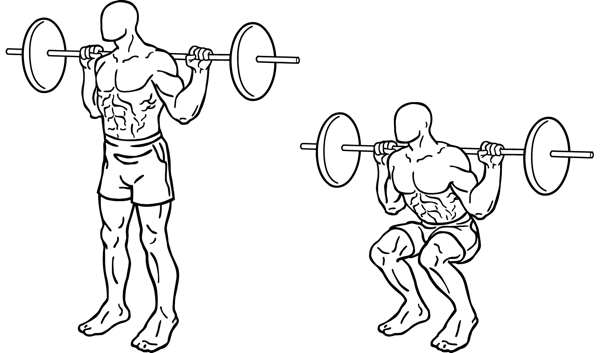
Squats. 6 sets. 95 lb. x15 (warm up), 135 lb. x 12, 185 lb. x 10, 205 lb. x 8, 205 lb. x 8, and finally 225 lb. x 5 (not very deep range of motion, it’s been awhile since I’ve attempted that weight.
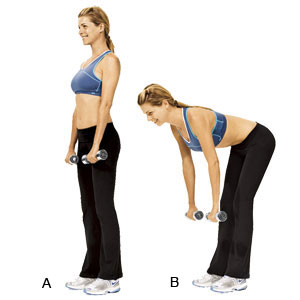
Romanian deadlift. 4 sets. Starting at 85 lb., then 95 lb., and 2 sets of of 110 lb. great hamstring, glute, lower back/lumbar strengthening exercise, but with a history of sciatica you have to be careful.
Dips. (click for video link) Body weight. 3 sets of 10
All big, multi-joint, compound movements. Total time 54 minutes. My body consumed 489 calories strictly weight training. No circuits. No aerobics. My goal was to enhance strength, and to force my body to put all those crap calories I’ve been forced to eat to the best possible use! Make sure you all put whatever you’re eating to use…you know where it goes if you don’t!
If my plan stays on track I’ll get back to the gym tomorrow and do a spin class. Thursday a hike at Camelback before turkey time. Then it’s back to NYC on Friday, and work on Sunday. Stay tuned to see if the plan holds up…
When a good trainer looks at a human body, they will instinctively start assessing it. We can’t help it. You’ll catch us looking you up and down. Looking at your front and backside. Looking at you from the side. Watching how you stand, and how you sit, and how you move. Maybe even how you sleep, if the circumstances permit. We do it because it’s our job, and since training rarely makes us rich, we do it because our job is our passion, and true passion can’t be switched off.
So what am I looking at (please assume I’m not being lecherous)?
1. I’m looking at your torso and upper extremities (arms, torso, abdomen, hips, from the front; gluteus (butt), lower and upper back, posterior deltoids (back of shoulder), neck, from the rear.
2. I’m looking at your hips and lower extremities (hips, quadriceps, knees, shins, ankles, and feet, from the front; hips/gluteus (butt), hamstrings, knees, calf, ankle, and feet, from the rear.
3. From the side I’m looking at your posture; the position of your head in relation to your shoulders (your cervical spine). I’m looking at the position of your shoulders and how it relates to your thoracic spine (mid back), lumbar spine (low back) and hip. I’m looking at how your hands fall at your side when relaxed (do they fall to the side or do they rotate in so that your palms face the front of your thighs. I’m looking at your hips to see if they are excessively extended back or are your hips tucked under you?
All of this is about your skeletal alignment, because how your skeleton aligns will determine how your body moves, and whether your muscles will move you with good healthy results. It will even determine if the appropriate muscles get activated. Have you ever seen an obsessive runner who has great thighs and a flat butt? That’s not genetics. That’s bad running form, often caused by an inability to properly activate the gluteus due to musculoskeletal movement problems (movement dysfunction). Now the question would be, is it due to a bad habit (learned dysfunctional movement) that simply needs to be “reprogrammed (not simple, actually), or is something inhibiting the normal movement pattern (injury, tight muscles)?
These assessments can occur anywhere, anytime. I find myself assessing strangers walking down the street, sitting in Starbucks, running in Central Park, and of course working out in the gym. It’s not a personal judgement, it’s an impersonal observation, that I make automatically. I get half of the information I need to set a person up on program in as little as 10 minutes if I can give them a few instructions. But there’s another aspect to this view as well.
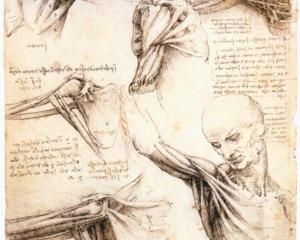
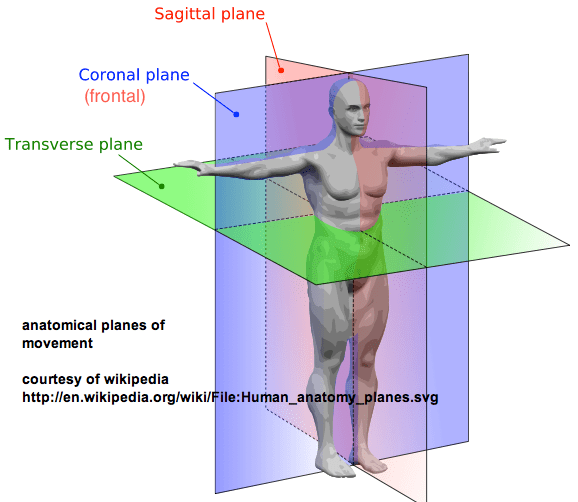
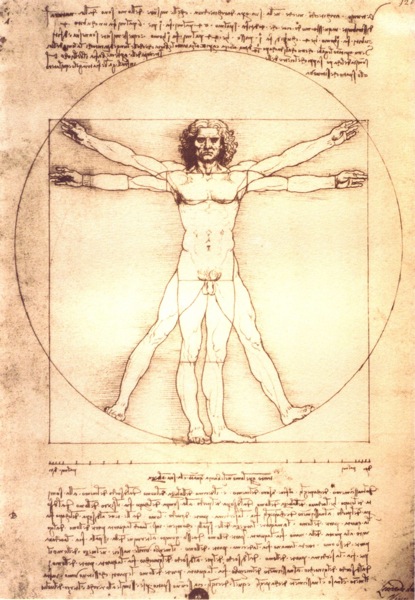
The diagrams above offer examples of how all good trainers organize the human body, and how we decide which muscles to work and in what order we work them. The one on the left was drawn by Leonardo Da Vinci. The other is a modern, 3 dimensional model. They show the human body and it’s “planes of movement”. Seem complicated? It’s not, but it confuses a lot of trainers too. Want to test a trainer in the gym? Go up to one and ask them “Can you tell me an effective exercise that works the transverse plane” (Pectoral fly’s)? That’s actually the easiest movement question you could ask, but outside of 3 or 4 trainers in any gym you’ll get a blank stare, and some fumbling. Or, can you name the largest muscles responsible for movement along the sagittal plane” (quads/glutes/hamstrings; i.e. walking)? The few somewhat sophisticated trainers will be able to answer these kinds of questions, but the really experienced ones realize that tidbit is just a stepping stone to true physical enlightenment.
In reality, these separations are almost completely unimportant when choosing exercises, as virtually every free weight exercise, or natural body movement, works in more than one plane simultaneously. Only when using weight lifting
Image via Wikipedia
machines (image on right) can the human body be forced to perform single plane movements because the machine stabilizes your body and restricts the movement pattern you can go through. This has some purpose with traditional body building, but in any athletic or weight loss endeavor, this is much less efficient. More movement = more potential calories expended. All athletics require multiple flowing movement patterns that require neurological coordination simultaneously and through these anatomical planes. But understanding these movement planes does offer some useful help. For one thing, it reminds us of the variety of possible motions in every joint action, and that movements that require two or more joints to act (compound movements) can and do work through multiple planes simultaneously. The greatest use this diagram serves is as an organizing principle. If I perform an exercise where I push my arms up, over my head, against pressure (Dumbbell shoulder press), than I should also do an exercise where I pull my arms down against pressure (lat pulldown). Each joint needs to be worked against resistance in every direction and in each plane it is capable of moving against.
When designing advanced weight lifting programs where we split the body parts worked into multiple days allowing for more intense workouts for every body part (many all around athletes, especially strength athletes find this advantageous at least part of their training year), being able to picture the above diagram helps to understand the multiple ways a person could effectively “split” their routine. You could easily see how to split your body at the transverse plane, working everything above the line on day 1, everything below the line on day 2, and continuing that pattern all week. Each major body part could be trained intensely three times in a week and have a full day off for recovery while the other half is targeted. You could also perform exercises for every muscular movement in front of the sagittal plane (all pushing movements) on day one, and all movements to the back of the sagittal plane (pulling movements) on day two, and continue to alternate throughout the week(s).
If you’re older, or just need more recovery time between body parts, then you can further split the body in logical ways with the above chart guiding you. If you have a decent vocabulary of exercises at your disposal, you quickly realize there are many more possible movements in the upper body, simply by virtue of the almost unlimited ranges of motion available at the shoulder joint. That means a two-day split is going to leave you with a very long upper body workout compared to the lower body workout. Or at least you’ll have a more boring lower body workout. But those upper body parts can be split too. I could do a total lower body workout on day 1, followed by all upper body pushes on day 2, with all upper body pulls on day 3. By the time you get back to the lower body, those muscles have now had 2 days of recovery. As will each group in succession. Allowing for less frequent, but often even more intense, workouts per day.
Don’t let this discussion lead you to believe that total body workouts are less useful, though. A baseball, basketball, football, or hockey player will get tremendous benefit out of total body routines that are tailored to their specific needs. A Quarterback or pitchers throwing motion and a batters swinging motion require such a complex, flowing, sequence of precise movements through almost every plane of movement, that they will absolutely utilize total body routines during certain points of their training cycles. The trick for everyone doing total body routines is to identify what their goal is and pick the most precise exercise movements to foster that end result. Do a few things intensely and precisely. When improving strength is the main goal, the split routines gain more prominence. When attempting to correct or better work around musculoskeletal imbalances, sometimes split routines can help place emphasis on the areas that need correcting.
And the point of everything is finding the method that works best now, realizing that in a few weeks or a few months, you will need to change direction to continue moving to where you want to go. And that diagram up there tells us where we need to go, and all the options we have to get there.
I’ve thought about this question; “why fitness? Why workout? Why compete in sports?”, for a long time. If I’ve learned anything about myself, it might boil down to one loaded word: overcompensation.
I was always smart. The Plainview school district where I grew up started administering intelligence tests in the 3rd grade. In the 5th grade my reading comprehension tested at 12th grade level. I was only average at things like math, but I could pretty much understand any concept. In the 11th grade I played chess grandmaster Shelby Lyman to a draw in a match that lasted over 3 hours. I was cutting classes to stay in the match and the principle was watching the last 60 minutes of it. It was the crowning moment in my love of chess. But I always felt I was cheating just a bit. I was born talented and smart the way some people are born beautiful, I hadn’t really earned it. I took it for granted, absolutely.
I was also born short. Slightly built to the point of puny. And a big nose. Smart, short, skinny, and a big nose, made me an easy target for bullies, but I had some less obvious physical advantages. I was crazy fast, possessed great reflexes, and I had a much older brother who I loved to rough house with, so I was tougher than I looked. I learned to make myself more trouble for the bullies than it was worth, using my brain, my speed, and a first strike policy if I thought a fight was inevitable. I was and am small, but my ego was (is) 10 feet tall. Did I mention I was competitive? Whatever I liked doing physically I needed to do as well as I possibly could. I hated losing in anything ifI believed I should win, and I hated not doing as well as I thought I could, even in defeat. I was always a good sport, but would obsessively work on improving my game. The sports I loved to play as a kid were Basketball and football. Did I mention I was puny? Didn’t matter. I played smart, I played fast, and I played big by surprising people with my unexpected strength. It wasn’t that I was super strong, it’s just that people underestimated me and I loved taking advantage of that. When opponents would adjust, even when they shut me down, I felt great; I forced opponents to notice me!
That started slowly changing with puberty, and the discovery that I really liked looking at girls but was at a total loss as far as interacting with them. I retreated. I was still short, puny, big nosed, and now pimply. All the girls were taller than me. I felt I was undesirable in the extreme. I was more comfortable with adults, books, and my art (I was a self-taught sculptor at 4), than with peers. People praising me for being smart or talented meant nothing to me though. These were gifts from fate (or genetics). I wanted, needed, to be acknowledged physically.
I was 17 when I got a job at a nearby gym the summer after high school graduation. If I was afraid of girls before, now it was worse! All these sexy women in their form-fitting leotards (it was the 80’s) and I’d never kissed a girl or been on a date, and was convinced no woman could want me. Low self-esteem. Low self-esteem came into conflict with the fact that I always felt special, above average, above normal, because of those natural gifts. High self-esteem. I started working out to make my body over in the image of my ego. I wanted to feel super strong and powerful. I wanted to earn it. I started building my body, from 5’6″ and 120 lb., to 150 lb. I started playing racquetball and soon became a top club player and a competitive “open” level player, competing in tournaments all over the northeastern seaboard. And women who liked athletic guys started noticing me. The popular athletic guys started wanting to hang out with me, started looking to follow me. I had re-invented myself. There was a cost. I became someone I’d grow to not like very much. It took time to reconcile low self-esteem me to my high self-esteem self.
Eventually I added an additional 20 lb. of muscle, getting to 170. I was really strong and felt compelled to keep pushing. By my mid 30’s I was stronger than anyone my size and un-augmented ought to be and the injuries started piling on. By then I’d learned a secret. All these people who were pulled into my orbit were being pulled in because I was smart and passionate and supremely confident in those attributes. My physical accomplishments had little effect on people’s behavior towards me. It was all about my attitude towards myself. I still want to be the best at whatever I do, but try to be smart enough to know what I can’t do. I haven’t beaten low self-esteem, and it still exerts its influence, but I have improved myself in some ways, taken backward steps in others. It is about health now, and a little more. I still dream of getting myself really strong, if I can do it smarter. I still like being the go to expert on anything I care about. There’s that ego again. Overcompensation isn’t always bad if you channel it right. Still working on figuring out how to tell the difference, 23 years later. The adventure continues…







 Fitnessgroan's Blog