Gluten-Free for the Gluten Sensitive – NYTimes.com

To eat, or not to eat (gluten), that is the question.
The article linked at the bottom is talking about wheat products. All wheat based products contain gluten, and depending on your health sources you should avoid it at all costs or not worry about it at all.

This NY Times piece is quite balanced and discusses the issue from each side of the divide, as well as from the point of view of real medical scientists. Keep in mind, that according to this story, the most recent study; conducted with scientific double blind placebo controls, had a sample size of 34 people. 34? Not 34,000. Not 3,400. Not 340. 34. Well, so much for conducting a definitive study.

I’ve personally never seen a reason to cut wheat glutens from my diet. Consuming wheat has never appeared to have a negative impact on my past performance as a pro racquetball player, a body builder, a runner, or a cyclist. I’ve never had a problem with energy levels or bloating. Those who are most vociferously aligned against wheat gluten seem to take it on faith and dubious pseudo science, or have an actual diagnosed case of celiac disease. The amorphous new “symptoms” newly medically recognized as “gluten sensitivity” seems to be growing, but whether its growth is legitimate or mass hysteria based on marketing is still up in the air. Many body builders and other physique minded people have been claiming for 2 decades that glutens cause bloating and negatively affect abdominal appearance.

Prior to the 1990’s, NO ONE seemed to have a problem with glutens (outside sufferers of celiac disease) and physique athletes didn’t seem to have a problem developing the sculpted bodies made of dreams. Arnold Schwarzenegger himself can be seen wolfing down an entire pizza pie immediately after winning his final Mr. Olympia title in the documentary Pumping Iron, and amid all the conversations the body builders have about nutrition in the film, no one mentions gluten sensitivity.

On the other hand, according to this article, the gluten content of breads has increased dramatically in recent years, and perhaps more people’s systems are unable to cope. It certainly deserves way more comprehensive study.

Do any of my readers have a gluten sensitivity related story to share?

A recent Facebook conversation between trainers

Recently, I posted something on Facebook by a nationally recognized fitness educator and trainer named Nick Tumminello. I didn’t feel like elaborating on it, and hadn’t planned on making it a personal blog post.

He posted the following picture with a link to a piece he wrote on his blog about why most people and even most athletes should stick to basic exercises but do them as intensely as possible:

20130202-191428.jpg

This Facebook post led to a Facebook debate between a coworker and I, which I have copy and pasted for your entertainment. The coworkers name has been removed to protect my safety (he’s much larger than me! Haha).

Just to be clear, I fully endorse cross training, and circuit training when done intelligently, with forethought about the goals of the trainee in mind. Those methods of training can provide dramatic and full range fitness and health benefits. That is not what CrossFit, P90X, and their various offspring will do for you.

CrossFit’s own website no longer touts it as an exercise regimen, but instead calls itself a “sport” and competition. However, since it uses exercises as its modus operandi, it has been and will continue to be, misused and misunderstood by the general public and seasoned “professionals” alike. You or I following or attempting CrossFit or ultimate cross whatever would be akin to watching an Olympic gymnast and then attempting to perform those same maneuvers the very next day.

The dialogue:
Coworker: Gotta love haters of extreme training. since most people do the basics in every gym, why hate on cross training?

Me: I love cross training. Cross fit and its brethren are not cross training. They are athletic training, sometimes “extreme” and sometimes not.
And if you think those pictures represent the “basics” you have a very different understanding of physical fitness than I do and we will leave it at that.

Coworker: Are you serious? Those pics are of Arnold doing massive weights. The whole point of this post is to say “stick with the bread and butter of power training cause doing “extreme” is bad. And since the squat and deadlift is in crossfit and are STAPLES of the sport, what are you getting at?

Me: Massive weights like that are the definition of “extreme”. As is the mental focus to push your lifts that hard. Since I’m heading to bed, I’ll leave it at this. Cross-fit type exercises simulate athletic style training camps mixed with powerlifting movements where certain skills are assumed. And none of the people in those videos developed their physiques doing cross fit. They came to cf already in extreme condition. Either young athletes or with years of intense training behind them. How many of your uxf’ers are already in extreme condition? How many are 18-24 and have the recovery ability of youth? How many have years of intense training behind them? None? How many will get there doing that kind of routine exclusively? None? Some of us are happy to be camp councilors. Me, I’m a fitness expert.

Coworker: way to be full of yourself. and alot of trainers here have extensive fitness backgrounds and certifications to back them up. everyone already knows that Cross-fit athletes come from different backgrounds. the whole point of the sport is to see which of those athletes are the fittest on earth. Also many others wasnt in extreme condition and got there by crossfit or other boot camp classes. There are several UXF trainers that ARE IN EXTREME CONDITION because some of them are current athletes. and nobody’s a “camp counselor”. we accept the fact that successful trends are needed for business to compete. Fitness is no different.

Me: Full of myself? Perhaps. But the Uxf trainers who are in extreme condition were in extreme condition before Uxf was even invented. Now they are skipping the steps to get in extreme conditioning with their clients in pursuit of entertainment and profit. Clients who will likely never achieve extreme condition because unlike those trainers and a few other exceptions, they will never adopt the extreme “lifestyle” necessary to achieve those ends.

And in case you were wondering:

The USMC recently funded a study into cross fit type exercise to replace traditional methods of strength and conditioning during basic training and concluded that it offered no increase in fitness over the duration of basic training compared to traditional methods, while at the same time increased the number of recruits unable to complete basic training DUE TO PHYSICAL INJURY 18% over the traditional methods. After 1 year of trials comparing units, the USMC has recommended that cross fit type exercises be banned from basic training. This was reported in the Journal of Strength and Conditioning special supplement on Tactical Strength and Conditioning.

Perhaps all those experts are full of themselves too.

The coworker did not respond after that.

We really do live and die this kind of stuff. Hope you got some insight into our “profession”.

Amino acid supplements and high intensity strength training

The critical role of proper nutrition with intense exercise use regimens cannot be overstated. The fitness industry is rife with myths, misinformation, faith based beliefs, inconclusive studies, and real hard science.

The role of protein supplements for strength and muscle building adherents is very well researched, and the abstract linked below published in the Journal of Strength and Conditioning is further evidence that if your exercise routine places you in the above categories, you should supplement.

The human body is a giant chemical factory. Whatever you consume is broken down into its simplest chemical components before it can be absorbed and used by the body. All carbs are turned into simple glucose before they can be used. Pasta, bread, rice, apples, and broccoli, are all turned into glucose, and whatever micronutrients they contain (vitamins and minerals) before they are usable by our bodies.

Likewise, proteins are broken down, but instead of glucose, proteins are turned into amino acids (plus whatever micronutrients are present) before they can be absorbed. Some proteins can be broken down more quickly than others, just like some carbs can be broken down faster than others. Sugar is so close to glucose its almost instantly absorbed. Whey is so close to digestible form it to is rapidly broken down into amino acids and absorbed. Taking amino acids directly that the absorption, like sugar, is almost instant, allowing for precise timing for maximum benefit. With this introduction by me, read the science:

http://mobile.journals.lww.com/nsca-jscr/_layouts/oaks.journals.mobile/abstractviewer.aspx?year=2010&issue=04000&article=00033

Loosen Up: 4 Yoga Poses For Tight Hamstrings

The fitness world is a funny place to live. Very knowledgeable fitness experts will gladly tell the world the right, and wrong, ways to train. “Do this, never do that” kind of things.

The official term for movements and exercises that we recommend never doing is contraindicated. There are a lot of reasons an expert or the entire industry might declare something contraindicated, but the majority of the time it’s because the reasoning behind the exercise is outside the scope of knowledge of the expert or the expert and the industry at large doubts our ability to perform the exercise correctly, and the risk of injury in that case out ways the potential benefit of doing it right.
There are a lot of reasons people have a difficult time performing certain exercises with proper form, but the 4 most common reasons are:
1) we don’t pay attention when being taught

2) our muscles are so tight and out of balance we can’t move thru the range of motion properly

3) our muscles are moderately tight and inhibit our movement so that when we attempt to attain a certain range of motion; that was arbitrarily set based on a non existent norm; our form breaks down

4) we weren’t taught properly to begin with; either the trainer rushed through the exercise instruction or didn’t know how to do it properly themselves.

Regardless, remember that when you look at an illustration of how an exercise ought to be performed you are being shown an ideal, perfect situation, one that seldom exists and in our cases probably never can exist. Use the image as a guideline. Move as though you were attempting to mimic that image, and stop the movement at just before the point where you cannot maintain the proper form. This is true with weight lifting. This is true with yoga. Now read the article so you can improve your abilities to whatever degree is possible.

Loosen Up: 4 Yoga Poses For Tight Hamstrings
http://www.fitsugar.com/Yoga-Poses-Tight-Hamstrings-26322247

Shared via News360

My workouts…

So the first week of my new regimen went like this: Chest & Back

CHEST

  1. Olympic flat bench press Set 1: 95lbs x 15 reps (warm up) 60 second rest Set 2: 135 x12 reps (deeper warm up) 60 second rest Set 3: 185 x 3 (heavy warm up) 90 second rest Set 4: 185 x 7 reps ( near muscular failure) 90 seconds rest Set 5: 185 x 6 reps (near muscular failure) 90 seconds rest Set 6: 185 x 3 reps (momentary muscular failure) 90 seconds rest 
  2. Dumbbell incline press 45lbs x 12 reps 60 seconds rest, 55 x 10 reps 60 seconds rest, 65 x 6 reps (momentary muscular failure) 90 seconds rest
  3. Standing Cable Fly (free motion machine on 4th floor): 70 lb. x 15, 80 lb. x 11, 90 lb. x 8 (momentary muscular failure) all sets had a 90 second rest between them

BACK

  1. Pull Ups Set 1: body weight (164 lb.) x 3 reps.  Ended the exercise due to a severe twinge in my left biceps tendon (where the biceps muscle inserts into the crux of the elbow)
  2. Lat Pull down: 90 lb. x 15 reps (testing the arm) 60 second rest, 110 lb. x 10 reps 60 second rest, 120 lb. x 8 reps 90 second rest, 140 lb. x 2 reps (the twinge again; decided to switch the movement pattern from downward pull to inward pull)
  3. One Arm Cable Bent forward rows (using cable cross machine, bottom pulley): 100 lb. x 12 reps (performed with each arm before rest) 60 sec rest, 130 lb. x 8 reps 90 sec rest, 150 x 4 reps (momentary muscular failure achieved on each arm; no twinge issue)

Workout ended.  

There were no residual issues with my left arm afterward.  I did not perform lower body workout due to lack of motivation, and decided to skip the shoulder and arm day until I’m sure the left biceps issue has been resolved.  I did repeat the chest/back routine, with the exact same results including the biceps twinge.  I plan on truing to get thru the whole weeks worth of workouts again starting tonight.

Body Building: beyond aesthetics

I’ve been lost with my workouts lately.  I haven’t had a clear-cut goal, instead basing my workouts on  general health, some notion of (obsolete) athletic needs, and boredom.  Without some competitive outlet, I find my workouts to be aimless and somewhat pointless.  General health and fitness is so uninspiring to me.  None of these has kept me training at the level of consistency and intensity I ought to be maintaining for both optimal physical fitness and professional reasons.

Since I really don’t pursue any specific athletic avocations at this point in my life, training athletically is not only pointless, but also counter productive considering the physical impairments I keep exacerbating: sciatica, arthritic pain in my ankle and left hand digits, shoulder pain from years of over-use and abuse, to name a few.

The level of exercise I need to accomplish to maintain general health is likewise so easy for me to achieve I don’t feel like I’m accomplishing anything.

And boredom leads to demotivation and general lack of interest in my own personal fitness.

To remedy this I’m going to begin a good, old school, body building routine.  Nothing fancy.

Nothing overly athletic or complex.  Just basic body building and strength training, done with gradually increasing intensity over a period of weeks.  I’ll target different parts of my body on different days, using a three-day split routine.  The same exercises every week till I reach a strength and development plateau, and then I’ll redesign the routine to reach a new plateau, and so on.  The goal is simple: get specifically strong in certain exercises, and to generally strengthen every skeletal muscle as much as possible.  In addition to my other posts, I will log these workouts here, and post them, so that all my readers can see what I’ll be doing, and the challenges that I either overcome or succumb to, just like everyone else in the exercise community.

My split will be as follows:

  1. Chest & Back Monday and Thursday (DB bench press, Incline DB press, cable fly’s, Pull-ups, cable rows/long pull, cable high row)
  2. Lower Extremities Tuesday and Friday (squats, dead lifts, jump step ups, leg extension, prone leg curl)
  3. Shoulder, Arms, cardio Saturday (standing military press, db lateral raise, Standing e-z bar biceps curl, db incline biceps curl, dips, cable triceps pulldown, spin 30-45 minutes)

Light to moderate cardio will also be done on chest and back days, depending on energy levels, and on any other day energy, motivation, and time permit.  Abdominal and core work will be done at the end of every workout, depending on soreness.

Hopefully, you will find this log of my own workouts to be motivating, and heartening to see that we all face similar challenges, regardless of which direction we come from in this exercise community of ours.

Superior Training Tactics

There are so many fitness fads these days it’s almost impossible to keep track of them all, but it’s my profession, after all and I’m going to go through a number of the more popular ones after talking about why these fads and scams keep coming back.

Over the last 30 years, the general exercising public and competitive athletes have been on separate training trajectories. Prior to the 1980s, most athletes didn’t spend a lot of time in the gym lifting weights. Tennis players played tennis, did tennis drills on the court to practice strokes, footwork, and techniques, and maybe did some cardio work to improve aerobic capacity, but none hit the weight room. They were afraid it would make them bulky, slower, less agile, and muscle-bound. Basketball and baseball players followed the same logic. So did track and field runners. a marathoner ran miles and sprinters did wind sprints and middle distance sprints. Maybe shot putters lifted weights as that has a strong strength component, but that’s about it. NFL linemen, linebackers, and running backs always lifted weights, but the “finesse” positions of Quarterback, wide receiver, corner backs, punters and kickers, almost certainly did not.

Meanwhile, the gym industry started its major growth faze, with Arnold Schwarzenegger‘s https://i0.wp.com/assets.schwarzenegger.com/uploads/images/index/Arnold-Classic56.pngrising star leading the way, picking up the baton Jack LaLanne started with in the 1950’s and 1960’s.https://i0.wp.com/upload.wikimedia.org/wikipedia/en/thumb/6/64/Jack_LaLanne_51b.jpg/220px-Jack_LaLanne_51b.jpg

These men were about physical fitness and; LaLanne especially; physical health and well-being. They might’ve performed athletic events (Schwarzenegger was a competitive power lifter before he became a body building champion, and LaLanne performed feats of strength and athleticism to highlight what physical fitness made possible. Interestingly, when Arnold was 19 he participated in a publicity strength challenge against 54-year-old LaLanne and LaLanne kicked Arnold’s ass!

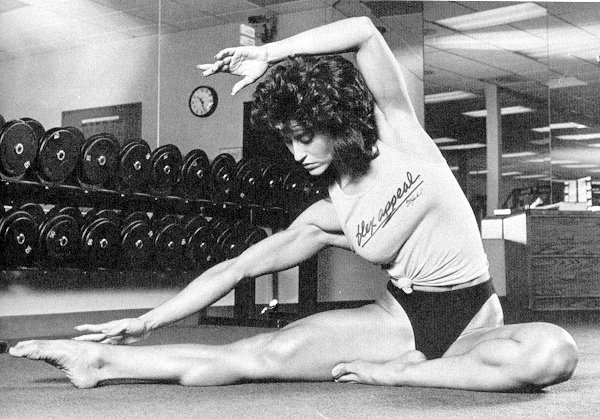
Unfortunately, there were few female icons involved at this stage. LaLanne tailored his pioneering TV show to housewives, and did frequently showcase his wife. As a matter of fact the most popular professional female body builder of the 1970s and early 1980s was Rachel McLish, but the vast majority of female gym goers thought she was way to muscular and unfeminine to be considered a role model. To male body builders, she was hotter than a Playboy Playmate.
741294275

I think today, she would be almost considered perfect. Back then, most women recoiled in horror at her overly muscular physique! Click on her picture to see even more of this “unfeminine” woman (I always thought she was a true ideal)

Getting back to the point, with these two men as the inspiration, Americans started going to the gym in increasing numbers and lifted weights. Around this time another pioneer, Dr. Kenneth Cooper (Cooper Aerobics Center)of the US Air force published studies he did on servicemen showing the benefits and importance of cardiovascular fitness. He is called the father of Aerobics, and in fact coined the term “Aerobics” in the first place. A number of books by runners came out and the running boom began. This was all serious training. Logging long hours doing miles of running and hitting the gym to lift serious weights (subjective to the individual, of course) and this was work.

The problem was, most people don’t want to do hard physical work, and like any business, the fitness industry wanted to make more money, and that required more bodies in the gym. How do you make grueling, dedicated hard work fun?

Enter the age of recreational fitness, and STEP and Jazzercize were its first and second offspring. Originally, step was a very good workout, and very aerobic, as the choreography was simple and required very little skill to master. You made it harder by increasing the number of risers, and by moving faster. But slowly, creative impulses and waning attendance demanded change to keep the masses coming back. Choreography became more dance like (fun), more complicated, and required increasing levels of skill to perform without pause. Eventually, as much of the class time was spent watching and learning intricate choreography as actually moving vigorously. The class would be standing still the instructor breaking down the moves in slow motion, then having the class perform the single move back repeatedly, then learning another step, and so on, as if they were getting ready to put on a dance show. Half the hour is spent doing nothing physical at all, and steps had to be much lower to perform the complicated choreography.

Moving forward in time, athletes and their coaches started realizing that being physically stronger enhanced just about every athletic endeavor, and they slowly but surely incorporated traditional strength training into all their routines. Even the best swimmers now spend hours every week lifting weights to get physically stronger.

Meanwhile, in the consumer health club, men were dropping out of organized group fitness classes faster than raindrops fall during a tropical storm, and everyone who remained noticed they weren’t losing weight anymore. The public, looking at their athletic heroes, noticed how hard the athletes bodies looked and concluded it was all that athletic training that the athletes did, and group exercise classes got a second wind. Members started participating in all kinds of sports conditioning type classes; boxing, kickboxing, cardio kick boxing, sports conditioning, yoga, ballet workouts, P90X, Crossfit™, TRX™; while the athletes themselves spent ever greater time lifting boring old weights. Click on either Crossfit or P90X above to read a journal article about the research, but here’s the conclusion of the study:

In summary, though ECPs (extreme conditioning programs) such as CrossFit and P90X are very popular, this popularity does not appear to be warranted. There is little evidence from peer-reviewed studies that ECPs are safe and/or effective, particularly when compared to established training programs documented to improve military task performance. Though much more research needs to be conducted, ECPs do not seem, at this time, to represent training programs likely to improve military readiness.by Guy Leahy, Med, CSCS,*D

Club members aren’t looking any fitter, by and large, but are, according to the Journal of Strength and Conditioning and the Journal of the American Medical Association dealing much higher frequencies of exercise related injuries. Athletic Performance has nothing to do with health, and everything to do with winning at all costs. Is this your goal? Is this important to you? Have you even thought about it?

Ask yourself why you go to the gym. Is it to get healthy, fit and strong, and to improve your appearance? Is it to improve your athletic performance in competitive or recreational sports? Is it recreational for you, in and of itself? All are valid, as far as I’m concerned, but you must be willing to match your reason to your method.

In conclusion,

If you’re trying to get healthy, fit, and strong to improve the quality of your life, be careful about’ training athletically! You will get hurt. Repeatedly. and 10, 15, or 20 years later you will feel every one of those injuries for the rest of your days. If you’re training because you’re a recreational or competitive athlete, make sure you pick a training style that transfers well to your sport of choice, and lift weights to enhance your physical abilities and reduce your risk of injury because you have a strong musculoskeletal foundation that can better withstand the stresses of athletics. If going to the gym is, in fact, your favorite form of recreation and entertainment, in and of itself, make sure you have a daily plan that minimizes your risk of injury so that you can continue for the long-term. Overtraining and improper form from overly complicated skill drills will have you convalescing at home far to frequently otherwise.


NYTimes.com: Why Women Can’t Do Pull-Ups

This is one of the good articles.  It’s actually accurate.  I myself have helped train 5 women over 28 years to be able to perform a pull up.  Sadly, that’s a statistic I’m proud of, since I know the extreme disadvantages women have in upper body strength.  Anyway, read and enjoy.

The New York Times E-mail This
This page was sent to you by: scott.salbo@gmail.com Why Women Can’t Do Pull-Ups
spacer.gif
spacer.gif
Advertisement
article tools sponsored by HITCH_NYT336x90_Oct11.gif
Copyright 2012 The New York Times Company | Privacy Policy

Advanced Heart Rate Training for muscular conditioning

I gave a workshop to some trainers today.  I showed them the following training technique, and thought some of my blog followers might find it challenging and rewarding to try.  Some of my current and recent clients have gone through differing versions of it, and they should feel free to give their honest appraisal if they are paying attention to all my blog posts.  You know who you are, out there…

So when reading this, remember that wherever I write client, that would refer to YOU.  Feel free to ask questions, and if any trainers want to use it I just ask that you credit me and refer those clients to my blog.

Enjoy.


Advanced Heart Rate Training for MusculoSkeletal Conditioning

  1. What is it?
    A. Results Oriented Training

    1. Get a heart rate monitor: Stop guessing if the client is working out hard
    2. Get the de-conditioned client in shape first, then add athletics/athletic movements
    3. Build the client up slowly

    B. Determining where to start

    1. Discover true resting heart rate and exercise zones using Karvonen formula (220 – age – RHR x 60% & 85%, adding RHR back in to both ranges)
    2. Don’t forget about Rate of Perceived Exertion, especially with beginners
    3. The truth about max heart rate: (it’s not really age predicted; get a stress test to determine your true max heart rate)
    4. It is helpful if you do strength assessments beforehand to determine starting points in major exercises
  2. How to begin
    A. Have the client wear a heart rate monitor for the entire session

    1. Warm up the client to get them to 60% THRZ
    2. Focus on major muscle groups and compound (multi-joint) movements. Set up a Circuit of weight lifting activities, always alternating lower and upper muscle groups, or opposing muscle groups, one after the other (4 or more exercises strung together; the more activities, the greater the overall intensity becomes).  Don’t add too many exercises to the circuit as the time between body parts is resting the muscle(s), and too much rest is counter productive
  1. Monitoring heart rate, push the client through the circuit until their heart rate (or perceived exertion) hits or just exceeds 85% of max, allow recovery until 60% THRZ is approached (do not allow the client to fall below 60%)
  2. For the de-conditioned individual, rate of perceived exertion might take initial precedence, as their tolerance to intensity might be lower
  3. For the conditioned client, you can eventually push well above 85% THRZ, and you can manipulate their low-end to higher percentages as their tolerance improves. Continue to ask how they feel; perceived exertion is never ignored

B. Never sacrifice form for speed. We are not training competitive athletes, and this is not an athletic or recreational event

  1. Our clients are mostly out of shape and/or middle-aged
  2. Allow water breaks as needed
  3. If doing multiple circuits start more complex movements and add less complex movements to subsequent circuits as fatigue sets in
  4. Don’t be afraid to improvise and modify on the go if the client is having trouble with a movement or the club gets busy and equipment becomes un-available (know your movement exercises and the closest equivalents if you have to modify)

III. Conclusion

  1. Keep it simple. Train what you really know. Don’t pretend to be an expert. Brain surgeons don’t perform heart surgery, orthopedic surgeons don’t perform brain surgery, and I don’t teach boxing (because I’m not a boxer). Stay within your knowledge base and make your clients work.
  2. This protocol will radically improve cardiovascular fitness and aerobic capacity.
  3. It will promote extreme weight loss (if diet is under control)
  4. It will promote intense muscular conditioning, developing lean muscular physiques
  1. This routine follows the GAS principle (general adaptation syndrome). It improves general overall fitness (muscular conditioning, aerobic and cardiovascular capacity) but does not improve specific activities like running or cycling (SAID principle: specific adaptation to imposed demands).
  2. This program is an exercise protocol, not an athletic event or recreational activity. Know the difference. 

    a.  It is meant to improve the body’s ability to tolerate those activities. Tennis players strength and cardio train. Football players strength and cardio train. Baseball players and hockey players and soccer players and basketball players and olympic gymnasts all strength and cardio train. 

    b.  If you want to train like an athlete, you can’t cherry pick. Weight and cardio training will reduce your risk of getting an injury from athletic training. And don’t complain when you get hurt while doing athletic training, even if you do the prerequisite and requisite strength and cardio training. Athletic training is a very high risk activity.

Here is a sample routine to follow:

Squats/Pull Ups or Bent over dumbbell rows/walking lunges or jump lunges/ push ups

4-6 sets, 10-20 reps each exercise, done in sequence with no or minimal rest time between exercises, except as indicated by a heart rate monitor and staying within 60-85% TMHR (theoretical max heart rate).  If the high target zone is exceeded, allow rest to occur without allowing HR to drop below 60% (resume at 65%).  Pick up the circuit where you left off, and continue until the next rest is required.

By Scott Salbo, AHRT systems
Physio-Active Response Training (PART