I’ve been lost with my workouts lately. I haven’t had a clear-cut goal, instead basing my workouts on general health, some notion of (obsolete) athletic needs, and boredom. Without some competitive outlet, I find my workouts to be aimless and somewhat pointless. General health and fitness is so uninspiring to me. None of these has kept me training at the level of consistency and intensity I ought to be maintaining for both optimal physical fitness and professional reasons.
Since I really don’t pursue any specific athletic avocations at this point in my life, training athletically is not only pointless, but also counter productive considering the physical impairments I keep exacerbating: sciatica, arthritic pain in my ankle and left hand digits, shoulder pain from years of over-use and abuse, to name a few.
The level of exercise I need to accomplish to maintain general health is likewise so easy for me to achieve I don’t feel like I’m accomplishing anything.
And boredom leads to demotivation and general lack of interest in my own personal fitness.
To remedy this I’m going to begin a good, old school, body building routine. Nothing fancy.
Nothing overly athletic or complex. Just basic body building and strength training, done with gradually increasing intensity over a period of weeks. I’ll target different parts of my body on different days, using a three-day split routine. The same exercises every week till I reach a strength and development plateau, and then I’ll redesign the routine to reach a new plateau, and so on. The goal is simple: get specifically strong in certain exercises, and to generally strengthen every skeletal muscle as much as possible. In addition to my other posts, I will log these workouts here, and post them, so that all my readers can see what I’ll be doing, and the challenges that I either overcome or succumb to, just like everyone else in the exercise community.
My split will be as follows:
Chest & Back Monday and Thursday (DB bench press, Incline DB press, cable fly’s, Pull-ups, cable rows/long pull, cable high row)
Lower Extremities Tuesday and Friday (squats, dead lifts, jump step ups, leg extension, prone leg curl)
Shoulder, Arms, cardio Saturday (standing military press, db lateral raise, Standing e-z bar biceps curl, db incline biceps curl, dips, cable triceps pulldown, spin 30-45 minutes)
Light to moderate cardio will also be done on chest and back days, depending on energy levels, and on any other day energy, motivation, and time permit. Abdominal and core work will be done at the end of every workout, depending on soreness.
Hopefully, you will find this log of my own workouts to be motivating, and heartening to see that we all face similar challenges, regardless of which direction we come from in this exercise community of ours.
This is one of the good articles. It’s actually accurate. I myself have helped train 5 women over 28 years to be able to perform a pull up. Sadly, that’s a statistic I’m proud of, since I know the extreme disadvantages women have in upper body strength. Anyway, read and enjoy.
Everyone is looking for the magic routine or the magic exercise, as if there is some secret that will transform your body better, quicker, easier, than any other. Sorry. That doesn’t work. People always assume that the advice they can get from some super trainer of celebrities is going to work better than they could get from their neighborhood gym trainer. Uh-uh. The advice you get from any trainer is going to be the same crap shoot you’d get from any other trainer. You have no way of knowing if the advice is good or bad unless you have good knowledge to know better yourself, and the average gym goer simply doesn’t.
This brings me to one of my personal issues with training blogs, in general. Most of the blog posts out there (and I subscribe to more than a few) seem to focus on describing killer routines or Best Butt Busting exercises (or any other body part you might want to develop). They can’t all be the best, can they? This is sensationalism at it’s most idiotic.There is no magic and there are no shortcuts. There is knowledge and evidence based training, and there is bullshit. Every exercise is a tool, but not every tool is appropriate for every job.
The problem I have with these posts is that there seems to be an assumption that the reader will understand how to do these workouts and exercises properly, and be able to integrate them into their existing workouts effectively. Inevitably, someone writes in how following so and so’s advice led to a major knee, lower back or other musculoskeletal injury and that so and so doesn’t know what they’re talking about and is a horrible trainer. Most of my readers are not fitness professionals or professional athletes, and I have no way of knowing if any specific advice I give will be followed properly, but I will be held responsible by that person if anything goes wrong. It almost never seems to occur to these complainers that perhaps they did the exercises badly, or improperly implemented the advice. All the same, I fault the Fitness expert writing for not properly qualifying their advice. I also blame them for giving too much of this kind of advice. Every other post seems to tout this or that exercise as the best for a specific muscle group, and the posts in-between talk about this or that routine as being the greatest. As these bloggers and professional writers are far and away the most popular, I suppose I can’t totally condemn them.
That said, people still want to know: what is the best exercise routine a person can follow for overall fitness? So here it is, a routine that will absolutely get you in great shape if you do it fervently every other day till the day you die, assuming you follow all the rules of intensity that I’ve laid out innumerable times and you are otherwise physically healthy with no major pre-existing injuries:
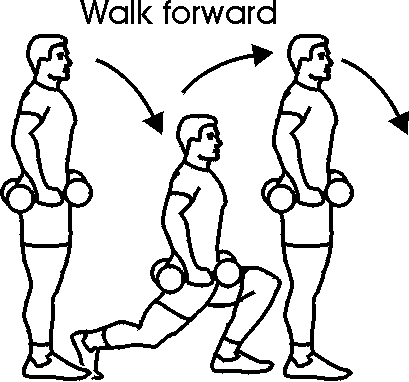
Walking Lunges with dumbbells: perform up to 7 sets, with rep ranges between 12 steps and 30 steps, so long as the last 3 steps of every set are exhausting.
Pull ups/Lat Pulldowns: perform up to 7 sets, with rep ranges between 6 and 15 reps, making sure the last rep of every set is almost impossible to complete.
A US Marine Doing Pull-ups. (Photo credit: Wikipedia)
Push Ups (toes or knees): perform up to 7 sets, as many reps as you can with good form on every set (even if it’s 50 reps on the 1st and 2 reps on the last).
English: an exercise of chest (Photo credit: Wikipedia)
Make sure you know how to do every exercise correctly, or get a trainer to show you. Just doing these three exercises, in the routine I’ve laid out for you, is the most perfect and magical workout ever devised by mortal man. Do this every other day, throw in cardio on in-between days. Don’t forget to eat like a champion athlete and sleep like a 10-year-old, and you will get into unbelievably great shape practically overnight (ok, in 6-12 months).
There are many variables for a beginner to think through when deciding how to start a training program in a gym setting.
The first thing a beginner needs to do (in reality, everyone needs to do this) is decide on a clear idea of what they want to accomplish. Need to lose weight? Build a little muscle? Are you training for something specific, like a New Years resolution to run the NYC Marathon this year? Have you decided to take up a sport or activity like tennis or cycling? All of these considerations need to be taken into account if you intend on actually accomplishing anything in a reasonable amount of time.
For the teenager and young adult, it tends to be mostly about aesthetics and social mingling…wanting to look better and meet people. For the 30’s-50’s somethings it tends to be some combination of aesthetics, mingling, specific training for a new hobby like tennis, and physical health. And once we hit the 60+ category, health tends to take paramountcy, though aesthetics almost always remain in the background. Humans never seem to stop wanting to look better… Keep in mind that there is constant debate among “experts” as to proper protocols and where to focus your beginning efforts. The main thing to remember is that as a beginner you need to develop a foundation of general fitness, as I’m assuming you’re starting from scratch, out of shape, and in a state of complete “de-conditioning”. That means you need to develop a baseline of aerobic fitness (think endurance), and musculoskeletal strength and coordination.
Many trainers will argue that you should start on exercise bikes or elliptical trainers and weight lifting machines, as these pose the lowest risk of accidental injury. I cannot agree with the latter. Weight lifting machines are important tools, but they do nothing to train foundational core coordination among all the normal musculoskeletal interactions that occur in real life movements. They are safer to do in the gym (from the health club’s liability perspective), but many experts (myself included) would argue that learning and depending on machines in the beginning leaves you more vulnerable to injury in real world situations because you don’t learn how to coordinate you body movements and your muscular system when you need to do some actual pushing or pulling. If you don’t know what your doing, hire a good trainer for a few lessons. It doesn’t have to be a long-term commitment if your goal is to learn how to do a few exercises correctly. If you make it a priority, almost anyone can afford 3 or 4 hours of proper instruction.
Also, if you have any pre-existing medical conditions or are starting out in your 40’s or older you should get yourself a good medical check up first. So let me take you through some exercise recommendations for the novice. Commit to 45 minutes/day, 4 times a week. And Don’t tell me you can’t fit that in, cause my bullshit detector will go off. It doesn’t matter if you’re tired after work, or a have a little muscular soreness from a previous workout at this level. Just show up and do the best you can. Any four days will do. Stick to this order. Follow this routine for 4-6 weeks. Don’t get fancy. Don’t improvise. And make sure you eat properly with quality proteins, carbs and unsaturated fats. If you’re trying to lose fat weight, cut down on portion sizes. If you’re trying to build and gain muscle weight, add 1 or two high quality small meals to your day. That’s it. No magic formulas.
Day one: bike or elliptical for 45 minutes. At level one, get your rpm (bike) or strides per minute (spm; elliptical) to about 80. Stay there for 10 minutes, then gradually begin increasing the level of difficulty by one, every 60-120 seconds (resistance or level) while maintaining a steady 80 rpm/spm. When you start huffing and puffing in order to continue, reduce your resistance down to a more comfortable level (not necessarily all the way down to 1 again) until your breathing becomes almost comfortable and your legs stop burning. Then repeat the process. Do this as many times as you can fit in for 30 minutes, then spend the last 5 minutes cooling down at level 1 at a slower speed. Done. Please read my blog posts on intensity, before starting this workout, here, and also here.
Animated cartoon on a exercise bike, Svenska: Animerad streckgubbe på en motionscykel. (Photo credit: Wikipedia)
Day two: Hit the weights. Start with Dumbbell Squats. You won’t know how heavy to go because you’re a beginner, so do a warm up set of 10 reps and see how hard it is to finish. If it feels less than a moderately intense effort; 7/10 on a ten point scale; then grab a set of light dumbbells and try again after resting 60-90 seconds. Keep trying until you determine that correct starting weights to use. Then do 3 sets of 10 reps with 60-90 seconds rest between each set. If you don’t know proper form, find a bench or low medium platform and sit on the edge of it while holding your weights. sit with good posture, then stand up strongly, slowly returning to the sitting position on the edge, without relaxing completely, and repeat. You are doing a “box” squat and all you need to do is remove the “box” when you get used to the movement pattern.
an exercise of thigh (Photo credit: Wikipedia)an exercise of thigh (Photo credit: Wikipedia)
Push ups come next. Do a warm up set of 6-10 reps, rest for 60-90 seconds, then try to complete 3 more sets, 10 reps (or as many as you can finish if you can’t finish 10) each, with 60-90 seconds rest in between each set. Push ups can be done modified (on knees) if proper form cannot be maintained.
an exercise of chest (Photo credit: Wikipedia
Next up are Lat Pulls . Since a 1st timer won’t know how much weight they can pull, the first set is an experiment. If you’re a male, try loading 50% of your body weight; if female try 30%. Attempt to complete 10 reps. If you cannot, make it slightly easier and try again after resting 90 seconds. If you completed 10 reps, and could have continued to do more, make it slightly harder, so that 10 reps becomes a real challenge (see this link on intensity). Do three fairly intense sets (7/10 perceived exertion), 10 reps each.
an exercise of upper back (Photo credit: Wikipedia)an exercise of upper back (Photo credit: Wikipedia)
Now it’s time for dumbbell shoulder presses. Like all the others, you first need to determine how heavy your dumbbells need to be. The same intensity rules apply. If you’re female, grab a pair of 7.5 or 8 lb. dumbbells, a male should grab a pair of 10-15 lb. dumbbells. Try to do 10 reps. match the weight and the reps to the desired 7/10 intensity, and make any weight adjustments (up or down) you need to in order to get the proper workout. complete 3 sets, 10 reps each, once the correct weight has been determined. This exercise can be done seated or standing, but avoid supporting you back against anything, if possible. Doing it without back support will enhance abdominal conditioning as well as the other associated muscles of the core.
an exercise of shoulders (Photo credit: Wikipedia)an exercise of shoulders (Photo credit: Wikipedia
That is the whole weight lifting workout. Every major muscle of your body has been stimulated to adapt and get stronger. Once you’ve really learned it it won’t take more than 30 minutes to complete. If you have energy left at the end, hop on an elliptical, bike, or treadmill and move at a moderate pace for an additional 15 minutes to get a little extra calorie burn and endurance training.
Day three repeats day 1
Day 4 repeats day two
Always remember to follow the intensity rules I’ve laid out in my previous blog posts (linked above, and here, here and here), for both weight training and cardio/aerobics training during the 4-6 weeks you will follow this beginner routine.




 Fitnessgroan's Blog