Great, GREAT article
http://www.livestrong.com/article/558455-3-ways-your-personal-trainer-steers-you-wrong/
Great, GREAT article
http://www.livestrong.com/article/558455-3-ways-your-personal-trainer-steers-you-wrong/

So the first week of my new regimen went like this: Chest & Back
CHEST
BACK
Workout ended.
There were no residual issues with my left arm afterward. I did not perform lower body workout due to lack of motivation, and decided to skip the shoulder and arm day until I’m sure the left biceps issue has been resolved. I did repeat the chest/back routine, with the exact same results including the biceps twinge. I plan on truing to get thru the whole weeks worth of workouts again starting tonight.
I’ve been lost with my workouts lately. I haven’t had a clear-cut goal, instead basing my workouts on general health, some notion of (obsolete) athletic needs, and boredom. Without some competitive outlet, I find my workouts to be aimless and somewhat pointless. General health and fitness is so uninspiring to me. None of these has kept me training at the level of consistency and intensity I ought to be maintaining for both optimal physical fitness and professional reasons.
Since I really don’t pursue any specific athletic avocations at this point in my life, training athletically is not only pointless, but also counter productive considering the physical impairments I keep exacerbating: sciatica, arthritic pain in my ankle and left hand digits, shoulder pain from years of over-use and abuse, to name a few.
The level of exercise I need to accomplish to maintain general health is likewise so easy for me to achieve I don’t feel like I’m accomplishing anything.
And boredom leads to demotivation and general lack of interest in my own personal fitness.
To remedy this I’m going to begin a good, old school, body building routine. Nothing fancy.
Nothing overly athletic or complex. Just basic body building and strength training, done with gradually increasing intensity over a period of weeks. I’ll target different parts of my body on different days, using a three-day split routine. The same exercises every week till I reach a strength and development plateau, and then I’ll redesign the routine to reach a new plateau, and so on. The goal is simple: get specifically strong in certain exercises, and to generally strengthen every skeletal muscle as much as possible. In addition to my other posts, I will log these workouts here, and post them, so that all my readers can see what I’ll be doing, and the challenges that I either overcome or succumb to, just like everyone else in the exercise community.
My split will be as follows:
Light to moderate cardio will also be done on chest and back days, depending on energy levels, and on any other day energy, motivation, and time permit. Abdominal and core work will be done at the end of every workout, depending on soreness.
Hopefully, you will find this log of my own workouts to be motivating, and heartening to see that we all face similar challenges, regardless of which direction we come from in this exercise community of ours.
a good post about a good book for all the cyclists.
There are so many fitness fads these days it’s almost impossible to keep track of them all, but it’s my profession, after all and I’m going to go through a number of the more popular ones after talking about why these fads and scams keep coming back.
Over the last 30 years, the general exercising public and competitive athletes have been on separate training trajectories. Prior to the 1980s, most athletes didn’t spend a lot of time in the gym lifting weights. Tennis players played tennis, did tennis drills on the court to practice strokes, footwork, and techniques, and maybe did some cardio work to improve aerobic capacity, but none hit the weight room. They were afraid it would make them bulky, slower, less agile, and muscle-bound. Basketball and baseball players followed the same logic. So did track and field runners. a marathoner ran miles and sprinters did wind sprints and middle distance sprints. Maybe shot putters lifted weights as that has a strong strength component, but that’s about it. NFL linemen, linebackers, and running backs always lifted weights, but the “finesse” positions of Quarterback, wide receiver, corner backs, punters and kickers, almost certainly did not.
Meanwhile, the gym industry started its major growth faze, with Arnold Schwarzenegger‘s  rising star leading the way, picking up the baton Jack LaLanne started with in the 1950’s and 1960’s.
These men were about physical fitness and; LaLanne especially; physical health and well-being. They might’ve performed athletic events (Schwarzenegger was a competitive power lifter before he became a body building champion, and LaLanne performed feats of strength and athleticism to highlight what physical fitness made possible. Interestingly, when Arnold was 19 he participated in a publicity strength challenge against 54-year-old LaLanne and LaLanne kicked Arnold’s ass!
Unfortunately, there were few female icons involved at this stage. LaLanne tailored his pioneering TV show to housewives, and did frequently showcase his wife. As a matter of fact the most popular professional female body builder of the 1970s and early 1980s was Rachel McLish, but the vast majority of female gym goers thought she was way to muscular and unfeminine to be considered a role model. To male body builders, she was hotter than a Playboy Playmate.
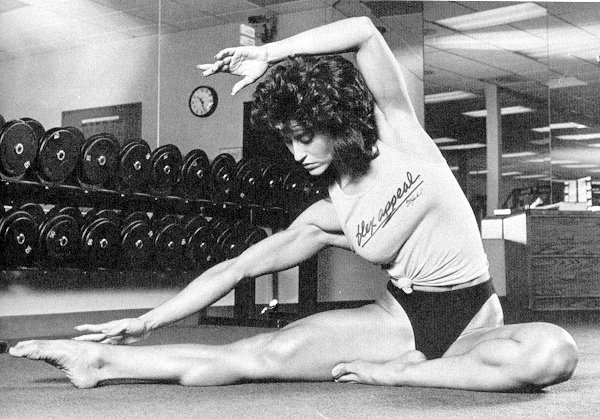
I think today, she would be almost considered perfect. Back then, most women recoiled in horror at her overly muscular physique! Click on her picture to see even more of this “unfeminine” woman (I always thought she was a true ideal)
Getting back to the point, with these two men as the inspiration, Americans started going to the gym in increasing numbers and lifted weights. Around this time another pioneer, Dr. Kenneth Cooper (Cooper Aerobics Center)of the US Air force published studies he did on servicemen showing the benefits and importance of cardiovascular fitness. He is called the father of Aerobics, and in fact coined the term “Aerobics” in the first place. A number of books by runners came out and the running boom began. This was all serious training. Logging long hours doing miles of running and hitting the gym to lift serious weights (subjective to the individual, of course) and this was work.
The problem was, most people don’t want to do hard physical work, and like any business, the fitness industry wanted to make more money, and that required more bodies in the gym. How do you make grueling, dedicated hard work fun?
Enter the age of recreational fitness, and STEP™ and Jazzercize™ were its first and second offspring. Originally, step was a very good workout, and very aerobic, as the choreography was simple and required very little skill to master. You made it harder by increasing the number of risers, and by moving faster. But slowly, creative impulses and waning attendance demanded change to keep the masses coming back. Choreography became more dance like (fun), more complicated, and required increasing levels of skill to perform without pause. Eventually, as much of the class time was spent watching and learning intricate choreography as actually moving vigorously. The class would be standing still the instructor breaking down the moves in slow motion, then having the class perform the single move back repeatedly, then learning another step, and so on, as if they were getting ready to put on a dance show. Half the hour is spent doing nothing physical at all, and steps had to be much lower to perform the complicated choreography.
Moving forward in time, athletes and their coaches started realizing that being physically stronger enhanced just about every athletic endeavor, and they slowly but surely incorporated traditional strength training into all their routines. Even the best swimmers now spend hours every week lifting weights to get physically stronger.
Meanwhile, in the consumer health club, men were dropping out of organized group fitness classes faster than raindrops fall during a tropical storm, and everyone who remained noticed they weren’t losing weight anymore. The public, looking at their athletic heroes, noticed how hard the athletes bodies looked and concluded it was all that athletic training that the athletes did, and group exercise classes got a second wind. Members started participating in all kinds of sports conditioning type classes; boxing, kickboxing, cardio kick boxing, sports conditioning, yoga, ballet workouts, P90X™, Crossfit™, TRX™; while the athletes themselves spent ever greater time lifting boring old weights. Click on either Crossfit or P90X above to read a journal article about the research, but here’s the conclusion of the study:
“In summary, though ECPs (extreme conditioning programs) such as CrossFit and P90X are very popular, this popularity does not appear to be warranted. There is little evidence from peer-reviewed studies that ECPs are safe and/or effective, particularly when compared to established training programs documented to improve military task performance. Though much more research needs to be conducted, ECPs do not seem, at this time, to represent training programs likely to improve military readiness.” by Guy Leahy, Med, CSCS,*D
Club members aren’t looking any fitter, by and large, but are, according to the Journal of Strength and Conditioning and the Journal of the American Medical Association dealing much higher frequencies of exercise related injuries. Athletic Performance has nothing to do with health, and everything to do with winning at all costs. Is this your goal? Is this important to you? Have you even thought about it?
Ask yourself why you go to the gym. Is it to get healthy, fit and strong, and to improve your appearance? Is it to improve your athletic performance in competitive or recreational sports? Is it recreational for you, in and of itself? All are valid, as far as I’m concerned, but you must be willing to match your reason to your method.
In conclusion,
If you’re trying to get healthy, fit, and strong to improve the quality of your life, be careful about’ training athletically! You will get hurt. Repeatedly. and 10, 15, or 20 years later you will feel every one of those injuries for the rest of your days. If you’re training because you’re a recreational or competitive athlete, make sure you pick a training style that transfers well to your sport of choice, and lift weights to enhance your physical abilities and reduce your risk of injury because you have a strong musculoskeletal foundation that can better withstand the stresses of athletics. If going to the gym is, in fact, your favorite form of recreation and entertainment, in and of itself, make sure you have a daily plan that minimizes your risk of injury so that you can continue for the long-term. Overtraining and improper form from overly complicated skill drills will have you convalescing at home far to frequently otherwise.

This is one of the good articles. It’s actually accurate. I myself have helped train 5 women over 28 years to be able to perform a pull up. Sadly, that’s a statistic I’m proud of, since I know the extreme disadvantages women have in upper body strength. Anyway, read and enjoy.
 |
|
|||||||||||||||||||

I gave a workshop to some trainers today. I showed them the following training technique, and thought some of my blog followers might find it challenging and rewarding to try. Some of my current and recent clients have gone through differing versions of it, and they should feel free to give their honest appraisal if they are paying attention to all my blog posts. You know who you are, out there…
So when reading this, remember that wherever I write client, that would refer to YOU. Feel free to ask questions, and if any trainers want to use it I just ask that you credit me and refer those clients to my blog.
Enjoy.
Advanced Heart Rate Training for MusculoSkeletal Conditioning
B. Determining where to start
B. Never sacrifice form for speed. We are not training competitive athletes, and this is not an athletic or recreational event
III. Conclusion
a. It is meant to improve the body’s ability to tolerate those activities. Tennis players strength and cardio train. Football players strength and cardio train. Baseball players and hockey players and soccer players and basketball players and olympic gymnasts all strength and cardio train.
b. If you want to train like an athlete, you can’t cherry pick. Weight and cardio training will reduce your risk of getting an injury from athletic training. And don’t complain when you get hurt while doing athletic training, even if you do the prerequisite and requisite strength and cardio training. Athletic training is a very high risk activity.
Here is a sample routine to follow:
Squats/Pull Ups or Bent over dumbbell rows/walking lunges or jump lunges/ push ups
4-6 sets, 10-20 reps each exercise, done in sequence with no or minimal rest time between exercises, except as indicated by a heart rate monitor and staying within 60-85% TMHR (theoretical max heart rate). If the high target zone is exceeded, allow rest to occur without allowing HR to drop below 60% (resume at 65%). Pick up the circuit where you left off, and continue until the next rest is required.
By Scott Salbo, AHRT systems™
Physio-Active Response Training (PART™)
One of my favorite exercise blogs is by Nick Tumminello. I’ve taken a number of workshops given by him at various fitness conferences and enjoy his down to earth no-nonsense approach. He makes it clear what we, as trainers, are often not doing what we are supposed to be doing: getting our clients in better physical shape and condition. Instead, we follow gimmicks and fads in the mistaken attempt to entertain our clients. I’ve often looked around my gym and wondered are we recreational camp counselors for adults or physical exercise specialists? I suppose each individual trainer has to decide for themselves, but i don’t think most realize there is any difference, just like most gym goers don’t give much thought to what they are trying to accomplish by going to the gym in the first place. It’s all just becoming another form of entertainment. I always worked out for three reasons:
1) Be attractive to members of the opposite sex
2) Improve my athletic performance in a number of sports
3) Improve my sense of self-esteem
The idea of exercising, in and of itself, as a form of entertainment, never made sense to me. I wanted to get in the most intense workout I could tolerate to get the eventual results I was aiming for in the shortest amount of time necessary and then go out and do something like play basketball, racquetball, or go rock climbing. The only reason I’d hang out in a gym any longer than necessary would be if I was flirting with someone!
I digress. The reason I wanted to remind you about Nick Tumminello is because he wrote a really good piece on the common exercise mistake of resting too long between sets. You should read it here.
Don’t forget, your methods have to match your goals every time you train. If you keep changing your routine, or your training protocols, you’ll never get anywhere with your fitness goals.
Just cool stuff. Imagine putting this intensity into you’re weekly workouts!
Space Jump Success: Baumgartner Leaps From 24-Mile Altitude
http://mashable.com/2012/10/14/space-jump-success/
Sent via Flipboard
“ Talent hits a target no one else can hit; Genius hits a target no one else can see. ” – Arthur Schopenhauer
What is the best possible protein supplement, who needs to take it, and when?
Any athlete, or those training like one, aught to ingest extra protein about 30 minutes after training, and it should come from whole foods, in a low fat, ratio of 4/1 carbohydrate/protein. The perfect post exercise recovery drink as it turns out is most likely low fat chocolate milk!
Cows milk contains 8 grams of protein and 12 grams of sugar (in the form of lactose), And 8 grams of fat, per serving (1 cup). The protein is a mix of two main types: whey protein (20%) and casein protein (80%). The chocolate syrup provides another 15-20 grams of sugar. I’m going to discuss the difference in those proteins, then get into carbohydrates, and nutrition in general.
As the article states, whey is a “fast acting” protein that is quickly absorbed into the blood stream for use by the body, while casein takes a little longer to be digested and used. Post exercise, this naturally occurring combo in milk provides the best option for immediate and overnight recovery.
But how much? All protein, when separated from its original source regardless of its chemical composition, works out to 4 calories per gram. Fish protein=4 calories. Steak protein=4 calories. Milk protein and peanut butter protein and soy protein; all 4 calories/gram. Depending on what you do in terms of exercise, an adult diet should consist of 20-30% protein.
An adult sedentary male should eat around 2000 calories a day to maintain a healthy weight. 20% protein would = 400 calories of protein; or 100 grams of protein per day. That 400 calories leaves this imaginary person with 1600 calories left to eat. 1600 calories that must come from carbohydrates and fat, the only other sources of calories a person can eat.
A carbohydrate is anything that can be turned into glucose easily during digestion. This includes sugar (in all its forms from refined table sugar to honey, agave, molasses, maple syrup, etc) to grains, fruits, and vegetables. Now, like protein, some sugars are fast acting (digest rapidly) and others less fast acting (digest relatively slower). This is not a value judgement on good and bad anymore than it was with the proteins. It’s a question of proper timing on your part. Fast digesting sugars help energize the body in the moment, and can aid in recovery immediately after exercise, while slower digesting carbs can help the body recover quickly, stay active over the long day, and continue to recover during sleep. That’s why chocolate milk is such a good post exercise recovery drink. The sugars and whey help with immediate recovery while the casein and the (low) fat content help with the longer term recovery.
All carbs are 4 calories/gram when separated from their parent source. Carbs from sugar, carbs from lettuce. Carbs from yellow peppers, potatoes, or rice, are all 4 calories. And 40-60% of imaginary mans 2000 calories per day should come from carbohydrates. Because our mystery man wants to eat as low fat a diet as possible like most health conscious people (though not me), lets say 60% carbs out of
the remaining 1600 calories for the day. thats 960 calories or 240grams of carbs.
That means our sedentary male has consumed 1360 calories from protein and carbs. 640 calories to go! But where can we get them?
Fat. Fat is a dense energy source containing 9 calories/gram. A calorie is simply a measure of energy, so 1 gram of fat has a drop more than twice the calorie (energy) of either protein or carbohydrate. All fats are comparatively slow to digest, and can aid in long term recovery (overnight) if properly timed during a day with exercise. You realize that there are “good” fats like fish and olive oil (unsaturated) and “bad” fats like those found in red meat (saturated). But regardless of whether a fat is “good” or “bad” (a different argument and blog post on that controversy) they are all 9 calories/gram. That means the remainder of this persons calories must come from fat; 71 grams of fat for the day to be precise; to get to a healthy calorie total. This person might tweak the carbs and protein up a bit to cut down the fat content, but either way, it’s a 2 for 1 exchange. He must add two grams of either protein or carbs for every 1 of fat he cuts. And there are definite downsides to that, as well.
There are nutritional exceptions: water and alcoholic drinks. Water has 0 calories, while alcoholic drinks are like super carbs, and possess 7 calories per gram (a chemical change that takes place during fermentation). So every serving of beer, wine, brandy, or scotch requires a reduction of calories. Two servings of carbs or proteins for every 1 serving of alcohol, or about an even exchange of fat for alcohol. The problem with alcohol is the more you drink, the less you’ll pay attention to making smart eating decisions!
The link below talks about protein supplements for athletic recovery, but lacks the context for the layman that I’ve sought to provide above.
http://nsca.com/Education/E-learning/Whey-Protein-vs–Casein-Protein-and-Optimal-Recovery/
“ Talent hits a target no one else can hit; Genius hits a target no one else can see. ” – Arthur Schopenhauer


 Fitnessgroan's Blog