There are so many fitness fads these days it’s almost impossible to keep track of them all, but it’s my profession, after all and I’m going to go through a number of the more popular ones after talking about why these fads and scams keep coming back.
Over the last 30 years, the general exercising public and competitive athletes have been on separate training trajectories. Prior to the 1980s, most athletes didn’t spend a lot of time in the gym lifting weights. Tennis players played tennis, did tennis drills on the court to practice strokes, footwork, and techniques, and maybe did some cardio work to improve aerobic capacity, but none hit the weight room. They were afraid it would make them bulky, slower, less agile, and muscle-bound. Basketball and baseball players followed the same logic. So did track and field runners. a marathoner ran miles and sprinters did wind sprints and middle distance sprints. Maybe shot putters lifted weights as that has a strong strength component, but that’s about it. NFL linemen, linebackers, and running backs always lifted weights, but the “finesse” positions of Quarterback, wide receiver, corner backs, punters and kickers, almost certainly did not.
Meanwhile, the gym industry started its major growth faze, with Arnold Schwarzenegger‘s  rising star leading the way, picking up the baton Jack LaLanne started with in the 1950’s and 1960’s.
These men were about physical fitness and; LaLanne especially; physical health and well-being. They might’ve performed athletic events (Schwarzenegger was a competitive power lifter before he became a body building champion, and LaLanne performed feats of strength and athleticism to highlight what physical fitness made possible. Interestingly, when Arnold was 19 he participated in a publicity strength challenge against 54-year-old LaLanne and LaLanne kicked Arnold’s ass!
Unfortunately, there were few female icons involved at this stage. LaLanne tailored his pioneering TV show to housewives, and did frequently showcase his wife. As a matter of fact the most popular professional female body builder of the 1970s and early 1980s was Rachel McLish, but the vast majority of female gym goers thought she was way to muscular and unfeminine to be considered a role model. To male body builders, she was hotter than a Playboy Playmate.
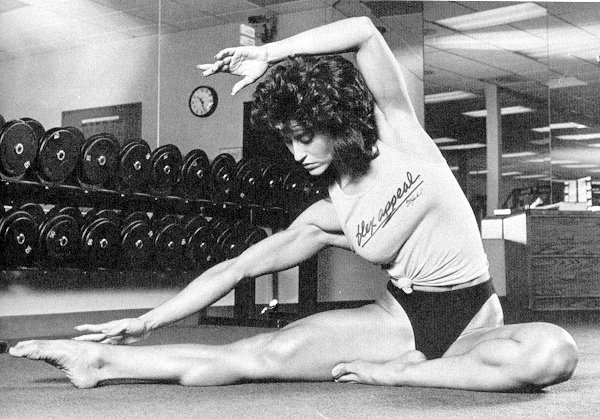
I think today, she would be almost considered perfect. Back then, most women recoiled in horror at her overly muscular physique! Click on her picture to see even more of this “unfeminine” woman (I always thought she was a true ideal)
Getting back to the point, with these two men as the inspiration, Americans started going to the gym in increasing numbers and lifted weights. Around this time another pioneer, Dr. Kenneth Cooper (Cooper Aerobics Center)of the US Air force published studies he did on servicemen showing the benefits and importance of cardiovascular fitness. He is called the father of Aerobics, and in fact coined the term “Aerobics” in the first place. A number of books by runners came out and the running boom began. This was all serious training. Logging long hours doing miles of running and hitting the gym to lift serious weights (subjective to the individual, of course) and this was work.
The problem was, most people don’t want to do hard physical work, and like any business, the fitness industry wanted to make more money, and that required more bodies in the gym. How do you make grueling, dedicated hard work fun?
Enter the age of recreational fitness, and STEP™ and Jazzercize™ were its first and second offspring. Originally, step was a very good workout, and very aerobic, as the choreography was simple and required very little skill to master. You made it harder by increasing the number of risers, and by moving faster. But slowly, creative impulses and waning attendance demanded change to keep the masses coming back. Choreography became more dance like (fun), more complicated, and required increasing levels of skill to perform without pause. Eventually, as much of the class time was spent watching and learning intricate choreography as actually moving vigorously. The class would be standing still the instructor breaking down the moves in slow motion, then having the class perform the single move back repeatedly, then learning another step, and so on, as if they were getting ready to put on a dance show. Half the hour is spent doing nothing physical at all, and steps had to be much lower to perform the complicated choreography.
Moving forward in time, athletes and their coaches started realizing that being physically stronger enhanced just about every athletic endeavor, and they slowly but surely incorporated traditional strength training into all their routines. Even the best swimmers now spend hours every week lifting weights to get physically stronger.
Meanwhile, in the consumer health club, men were dropping out of organized group fitness classes faster than raindrops fall during a tropical storm, and everyone who remained noticed they weren’t losing weight anymore. The public, looking at their athletic heroes, noticed how hard the athletes bodies looked and concluded it was all that athletic training that the athletes did, and group exercise classes got a second wind. Members started participating in all kinds of sports conditioning type classes; boxing, kickboxing, cardio kick boxing, sports conditioning, yoga, ballet workouts, P90X™, Crossfit™, TRX™; while the athletes themselves spent ever greater time lifting boring old weights. Click on either Crossfit or P90X above to read a journal article about the research, but here’s the conclusion of the study:
“In summary, though ECPs (extreme conditioning programs) such as CrossFit and P90X are very popular, this popularity does not appear to be warranted. There is little evidence from peer-reviewed studies that ECPs are safe and/or effective, particularly when compared to established training programs documented to improve military task performance. Though much more research needs to be conducted, ECPs do not seem, at this time, to represent training programs likely to improve military readiness.” by Guy Leahy, Med, CSCS,*D
Club members aren’t looking any fitter, by and large, but are, according to the Journal of Strength and Conditioning and the Journal of the American Medical Association dealing much higher frequencies of exercise related injuries. Athletic Performance has nothing to do with health, and everything to do with winning at all costs. Is this your goal? Is this important to you? Have you even thought about it?
Ask yourself why you go to the gym. Is it to get healthy, fit and strong, and to improve your appearance? Is it to improve your athletic performance in competitive or recreational sports? Is it recreational for you, in and of itself? All are valid, as far as I’m concerned, but you must be willing to match your reason to your method.
In conclusion,
If you’re trying to get healthy, fit, and strong to improve the quality of your life, be careful about’ training athletically! You will get hurt. Repeatedly. and 10, 15, or 20 years later you will feel every one of those injuries for the rest of your days. If you’re training because you’re a recreational or competitive athlete, make sure you pick a training style that transfers well to your sport of choice, and lift weights to enhance your physical abilities and reduce your risk of injury because you have a strong musculoskeletal foundation that can better withstand the stresses of athletics. If going to the gym is, in fact, your favorite form of recreation and entertainment, in and of itself, make sure you have a daily plan that minimizes your risk of injury so that you can continue for the long-term. Overtraining and improper form from overly complicated skill drills will have you convalescing at home far to frequently otherwise.




 Fitnessgroan's Blog