18 June, 2013 07:14

Here we go. The New York Times getting lazy again. This article isn’t wrong in what it says, it’s just so vague and incomplete that someone who hasn’t ever engaged in regular exercise before but is getting ready to try is likely to make some terrible mistakes. Lets add just a bit of important detail.

First, everything the article says is correct…when talking about aerobic/cardiovascular exercise. You can train multiple days in a row, and such frequency can enhance the quality of your workouts as your practice develops better skills at that particular activity (running, cycling, even power walking have skills that can be improved).

The reason you can perform these activities multiple days in a row is determined by their nature, which is described in the category name AEROBICS. Aerobics refers to both a human energy system and a certain range of physical intensity.

Aerobic type exercise typically falls into a category of intensity between 60% and 85% of a persons theoretical max effort. At these ranges of effort, a person can continuously exercise for 15 or more consecutive minutes before becoming too fatigued to continue. Within this range the entire cardiovascular system becomes healthier and stronger, and that’s great. But it’s only half (some might argue 1/3) your fitness journey.

Anaerobic exercise is the other half of this very important fitness story. Like aerobics, the term anaerobic refers to both a human energy system and a range of physical intensity for the activity. In Anaerobic exercises, the intensity MUST exceed 85% of a persons theoretical maximum effort, causing rapid exhaustion (under 60 seconds, typically, but always under 2minutes). Training in this range improves the tone, and physical strength, of a persons skeletal muscular system, improving the bodies posture, appearance, resistance to physical injuries, and later in life, infirmity and osteoporosis. Can you walk up a flight of stairs when your 80? Can you tie your own shoelaces? Can you carry a bag of groceries or get up out of a cushy sofa? These are matters of physical strength in the geriatric community, and major challenges to millions of Americans.

Training at this intensity level can not be performed on consecutive days, because training at this level actually causes a temporary weakening of the skeletal muscles involved, and the following 24-48 hours are needed for the muscles to recuperate and adapt in order to become stronger.

The Times article correctly states that 72 hours between exercise bouts is too long to wait for any exercise, but fails to caution that certain kinds of exercise require a certain amount of days off before repeating.

I hope this helps. Good luck.

http://nyti.ms/19ztI5l
NYTimes: How Often to Exercise

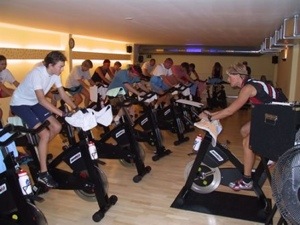
Indoor Cycling

20130611-174435.jpg

20130611-174502.jpg

There is no such thing as the best kind of exercise…but when it comes to cardiovascular training indoor cycling comes close.

20130611-174452.jpg

With a good instructor you’ll get an awesome cardio/aerobic workout helping you burn enormous amounts of calories, and that helps you control your weight and body fat. You will strengthen unarguably the most important muscle in your body; your heart. That’ll keep you alive. It will improve your lung capacity so you don’t get winded going up a couple of flights of stairs when an elevator is out.

There’s more benefits, too. Unlike a 1 mile (or longer run), cycling can incorporate anaerobic training. Anaerobic training uses different sources of energy and challenges the skeletal muscles of the legs and hips to a far greater degree than aerobic training is designed to. This builds true muscle tone and strength creating shape. And that shape also enhances your ability to generate more power to go longer distances at lower levels of intensity and to overcome obstacles like hills and rough terrain along the way, or going up those two flights of stairs with a couple of heavy grocery bags, too.

Spinning and other indoor cycling programs give you all these benefits. Running and other forms of aerobics can, as well, but because of the pounding impact of jogging, running, and other aerobic type classes you also dramatically increase your risks of injury.

You can find me at the new cycling boutique studio in Forest Hills: SUN CYCLE Studio Tuesdays at 6am and 6pm, and Saturday at noon and as always at New York Sports clubs in Forest Hills, Rego Park, and Manhattan locations at 38th & Broadway and 23rd & 8th. My schedule there has not changed.

Join me and all the other great instructors for a great indoor cycling ride.

Come get the ride of your life, and get in the shape you’ve dreamed about.

20130611-195236.jpg

Interesting…I love science

http://nyti.ms/13Emwi1

NYTimes: Is Barefoot-Style Running Best? New Studies Cast Doubt

Recent studies examining just how the body actually responds when we run in our birthday shoes or skimpy footwear suggest that for many people, running without shoes or in minimalist footwear does not make running easier, speedier or less injurious.

Exercise classes with you dog

As a dog owner and fitness professional, I find this intriguing. What are my readers thoughts?

http://nyti.ms/17AvDW4

NYTimes: Exercise Class, Obedience Not Required

In a new class in Brooklyn, dogs and their owners can work out and play together.

Salt and your health

This is important. Very, very important.
http://nyti.ms/16aD8TY

NYTimes: No Benefit in Sharply Restricting Salt, Panel Finds

Health experts for the government say there is no good reason for many Americans to keep sodium consumption below 2,300 milligrams a day, as national dietary guidelines advise.

Atheism and the Martial Arts

The problems with magical thinking…not really related to my blog, but understanding the difference between reality science based training and magical faith based beliefs is important. The lesson is the same. If only bad training could punch you in the face.. Read the interview through the part about the two video’s. then watch the video’s in order to get the magnitude of how anyone can get seduced into delusional beliefs and become CONVINCED it is real and true.
Then repeat this mantra “magic is make believe, or insanity when you can’t turn the make believe off”.

Here’s the link to the full article:
http://m.theatlantic.com/national/archive/2013/04/what-martial-arts-have-to-do-with-atheism/275273/

Scott

Heart health

This is important. One of the main adaptations of intense cardiovascular training is a lowering of the resting heart rate. The heart is a muscle. It’s job is to keep a steady consistent flow of oxygenated blood flowing through your body. The more powerful each beat is, the greater the volume of blood that is circulated PER heartbeat. A strong heart beats with greater power, and beats less often to do its job. A weak heart has to accomplish the exact same task, or you die, so if it can’t push a lot of blood per beat, it beats faster to get the same result.

A good analogy:
A strong man goes grocery shopping, and fills 5 heavy bags of groceries. When he gets home he grabs all 5 at once and walks up two flights of stairs to his apartment.

A weak man unloads his car of the 5 bags, brings them to his front stoop, and carries two bags up at a time. He has to make more trips to accomplish the same goal.

Now, imagine that both men had to accomplish that goal on the same amount of time, or they would lose the groceries to the other. Who would likely win?

We used to say that every heart has only so many beats in it. How true that sounds.

http://nyti.ms/ZxkvVf

NYTimes: Heart Rate as a Measure of Life Span

A higher resting heart rate is an independent predictor of mortality, even in healthy people in good physical condition, a new study suggests.

Reasons Not to Stretch – NYTimes.com

I’ve written about stretching numerous times, and the evidence has been steadily mounting against stretching as a warm-up modality prior to exercise, and these two real scientific studies add to that pile. The article is very well written and explains the studies clearly and why these studies are so compelling. The NY TIMES wellness blog continues its tradition of alternating excellent reporting with pointless and confusing filler; this piece being quite valuable. Read it.

This does not invalidate stretching as a legitimate form of exercise, however, and I’ll elaborate.

Almost all these studies; current and past; use real athletes as subjects. They are already well trained, fit, and lead an active lifestyle that helps keep their musculoskeletal system supple and more flexible than the average sedentary adult.

Inflexible muscles, muscular adhesions (muscles and connective tissue sticking together) and poor joint range of motion, can cumulatively impede your ability to move effectively and safely while exercising. Regular stretching can help alleviate and minimize these problems in many; if not most; cases.

So if you need to stretch, how do you incorporate it into your routine?

1. Stretch after your workout, never before.

2. If your muscles are super tight make stretching a separate workout altogether; do it on a day you aren’t doing any weight or cardio training.

3. Incorporate activities like vinyasa yoga or tai chi that focus on movement activities that force you to move through full ranges of motion.

4. Get deep tissue massage. It can really loosen you up. Again, only after a workout.

Read the post, linked below.
http://well.blogs.nytimes.com/2013/04/03/reasons-not-to-stretch/