Vacation workouts

I usually tell clients going away on vacation to take it easy, especially if it’s going to be an active trip with lots of walking and other physical activities.

This isn’t one of those trips. Visiting family for the holidays usually involves lots of sitting around, talking, catching up, and eating too much of everything including junk (is it just my family?)

I got to Phoenix on Saturday. Today, I finally got to a gym in the morning. LA Fitness. Big place, probably 3 or 4 times the size of NYSC in Forest Hills. Besides a large free weight section, a huge weight lifting machine section, 2 large cardio areas, a cycle room featuring Kaiser bikes, and a large aerobics studio. They also have 5 racquetball courts, and indoor full court basketball.

The gym was clean. Really clean, but no housekeeping was visible. The members cleaned up after themselves. Every piece of free weight equipment was in place, in order, and the members automatically put their own stuff away. It was a very nice environment to train in. So what did I train?

God knows when I’ll get back to the gym, so when in doubt, go big! I did big movements that incorporate all the major muscle groups and force core stabilization and recruitment. My workout today:

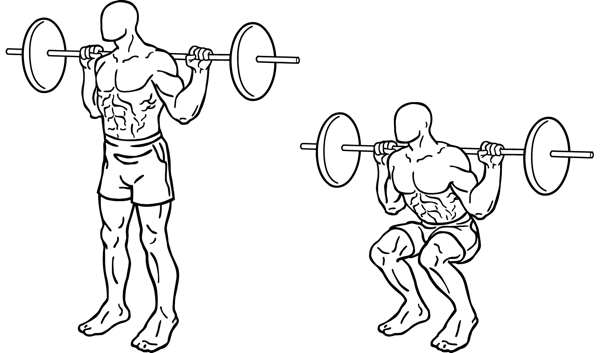
Squats. 6 sets. 95 lb. x15 (warm up), 135 lb. x 12, 185 lb. x 10, 205 lb. x 8, 205 lb. x 8, and finally 225 lb. x 5 (not very deep range of motion, it’s been awhile since I’ve attempted that weight.

Squats

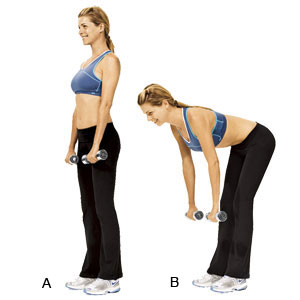
Romanian deadlift. 4 sets. Starting at 85 lb., then 95 lb., and 2 sets of of 110 lb. great hamstring, glute, lower back/lumbar strengthening exercise, but with a history of sciatica you have to be careful.

0611 rom deadlift

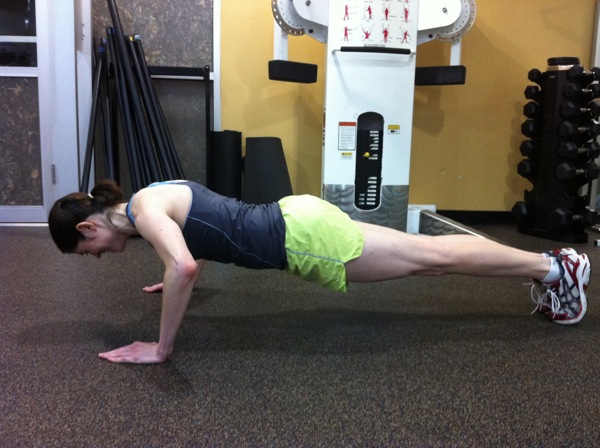
Push Ups. 60 in 2 sets as a warm up

IMG 5182

Dumbbell flat bench press (click for video link). 5 sets. 65 lb. x 11, 10, 8, 6. 75 lb. x 3.

Pull Ups. Body weight (161 lb.). 5 sets. 10, 9, 7, 5, 4.

Pullupic

Bent over, one arm, cable rows. (click for video link) 5 sets. 110 lb. x 12, 11, 8, 6, 6.

Dips. (click for video link)  Body weight. 3 sets of 10

All big, multi-joint, compound movements. Total time 54 minutes. My body consumed 489 calories strictly weight training. No circuits. No aerobics. My goal was to enhance strength, and to force my body to put all those crap calories I’ve been forced to eat to the best possible use! Make sure you all put whatever you’re eating to use…you know where it goes if you don’t!

If my plan stays on track I’ll get back to the gym tomorrow and do a spin class. Thursday a hike at Camelback before turkey time. Then it’s back to NYC on Friday, and work on Sunday. Stay tuned to see if the plan holds up…

Stretch, anyone?

I’m going to write more in this while I’m flying, but here’s a great link forwarded to me by our friend Thane:

http://well.blogs.nytimes.com/2011/11/16/the-right-reasons-to-stretch-before-exercise/?ref=health

Think about it after you read it and then check back Saturday or Sunday to see what I have to say.

The human body; a trainers view (mine, anyway).

When a good trainer looks at a human body, they will instinctively start assessing it. We can’t help it. You’ll catch us looking you up and down. Looking at your front and backside. Looking at you from the side. Watching how you stand, and how you sit, and how you move. Maybe even how you sleep, if the circumstances permit. We do it because it’s our job, and since training rarely makes us rich, we do it because our job is our passion, and true passion can’t be switched off.

So what am I looking at (please assume I’m not being lecherous)?

1. I’m looking at your torso and upper extremities (arms, torso, abdomen, hips, from the front; gluteus (butt), lower and upper back, posterior deltoids (back of shoulder), neck, from the rear.

2. I’m looking at your hips and lower extremities (hips, quadriceps, knees, shins, ankles, and feet, from the front; hips/gluteus (butt), hamstrings, knees, calf, ankle, and feet, from the rear.

3. From the side I’m looking at your posture; the position of your head in relation to your shoulders (your cervical spine). I’m looking at the position of your shoulders and how it relates to your thoracic spine (mid back), lumbar spine (low back) and hip. I’m looking at how your hands fall at your side when relaxed (do they fall to the side or do they rotate in so that your palms face the front of your thighs.  I’m looking at your hips to see if they are excessively extended back or are your hips tucked under you?

All of this is about your skeletal alignment, because how your skeleton aligns will determine how your body moves, and whether your muscles will move you with good healthy results.  It will even determine if the appropriate muscles get activated.  Have you ever seen an obsessive runner who has great thighs and a flat butt?  That’s not genetics.  That’s bad running form, often caused by an inability to properly activate the gluteus due to musculoskeletal movement problems (movement dysfunction).  Now the question would be, is it due to a bad habit (learned dysfunctional movement) that simply needs to be “reprogrammed (not simple, actually), or is something inhibiting the normal movement pattern (injury, tight muscles)?

These assessments can occur anywhere, anytime. I find myself assessing strangers walking down the street, sitting in Starbucks, running in Central Park, and of course working out in the gym.  It’s not a personal judgement, it’s an impersonal observation, that I make automatically.  I get half of the information I need to set a person up on program in as little as 10 minutes if I can give them a few instructions. But there’s another aspect to this view as well.

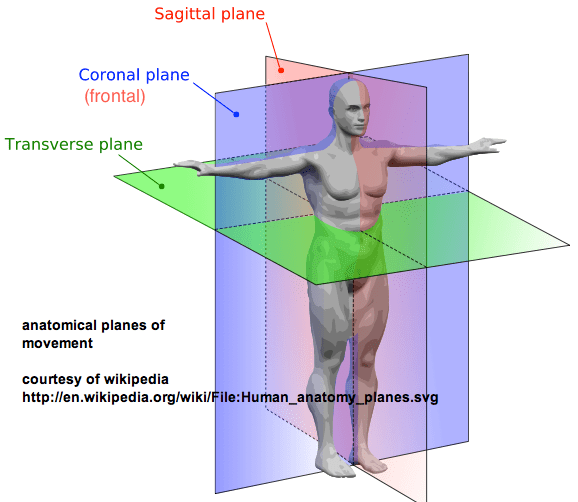
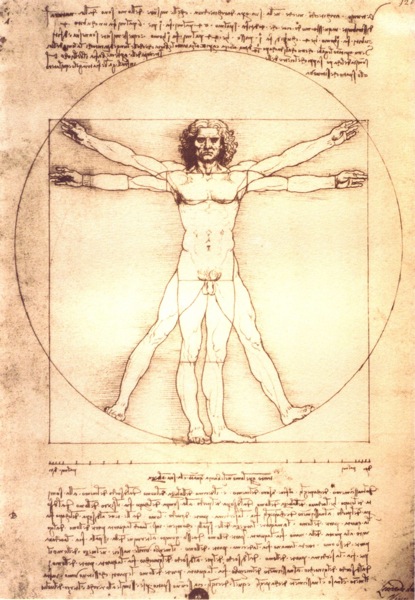
Anatomical planes chartVitruvian


The diagrams above offer examples of how all good trainers organize the human body, and how we decide which muscles to work and in what order we work them. The one on the left was drawn by Leonardo Da Vinci.  The other is a modern, 3 dimensional model.  They show the human body and it’s “planes of movement”.  Seem complicated?  It’s not, but it confuses a lot of trainers too.  Want to test a trainer in the gym?  Go up to one and ask them “Can you tell me an effective exercise that works the transverse plane” (Pectoral fly’s)?  That’s actually the easiest movement question you could ask, but outside of 3 or 4 trainers in any gym you’ll get a blank stare, and some fumbling.  Or, can you name the largest muscles responsible for movement along the sagittal plane” (quads/glutes/hamstrings; i.e. walking)?  The few somewhat sophisticated trainers will be able to answer these kinds of questions, but the really experienced ones realize that tidbit is just a stepping stone to true physical enlightenment.

In reality, these separations are almost completely unimportant when choosing exercises, as virtually every free weight exercise, or natural body movement, works in more than one plane simultaneously.  Only when using weight lifting

Supervised physical therapy may be helpful to ...
Image via Wikipedia

machines (image on right) can the human body be forced to perform single plane movements because the machine stabilizes your body and restricts the movement pattern you can go through.  This has some purpose with traditional body building, but in any athletic or weight loss endeavor, this is much less efficient.  More movement = more potential calories expended.  All athletics require multiple flowing movement patterns that require neurological coordination simultaneously and through these anatomical planes.  But understanding these movement planes does offer some useful help.  For one thing, it reminds us of the variety of possible motions in every joint action, and that movements that require two or more joints to act (compound movements) can and do work through multiple planes simultaneously.    The greatest use this diagram serves is as an organizing principle.  If I perform an exercise where I push my arms up, over my head, against pressure (Dumbbell shoulder press), than I should also do an exercise where I pull my arms down against pressure (lat pulldown). Each joint needs to be worked against resistance in every direction and in each plane it is capable of moving against.

When designing advanced weight lifting programs where we split the body parts worked into multiple days allowing for more intense workouts for every body part (many all around athletes, especially strength athletes find this advantageous at least part of their training year), being able to picture the above diagram helps to understand the multiple ways a person could effectively “split” their routine.  You could easily see how to split your body at the transverse plane, working everything above the line on day 1, everything below the line on day 2, and continuing that pattern all week.  Each major body part could be trained intensely three times in a week and have a full day off for recovery while the other half is targeted.  You could also perform exercises for every muscular movement in front of the sagittal plane (all pushing movements) on day one, and all movements to the back of the sagittal plane (pulling movements) on day two, and continue to alternate throughout the week(s).

If you’re older, or just need more recovery time between body parts, then you can further split the body in logical ways with the above chart guiding you.  If you have a decent vocabulary of exercises at your disposal, you quickly realize there are many more possible movements in the upper body, simply by virtue of the almost unlimited ranges of motion available at the shoulder joint.  That means a two-day split is going to leave you with a very long upper body workout compared to the lower body workout.  Or at least you’ll have a more boring lower body workout.  But those upper body parts can be split too.  I could do a total lower body workout on day 1, followed by all upper body pushes on day 2, with all upper body pulls on day 3.  By the time you get back to the lower body, those muscles have now had 2 days of recovery.  As will each group in succession.  Allowing for less frequent, but often even more intense, workouts per day.

Don’t let this discussion lead you to believe that total body workouts are less useful, though.  A baseball, basketball, football, or hockey player will get tremendous benefit out of total body routines that are tailored to their specific needs.  A Quarterback or pitchers throwing motion and a batters swinging motion require such a complex, flowing, sequence of precise movements through almost every plane of movement, that they will absolutely utilize total body routines during certain points of their training cycles.  The trick for everyone doing total body routines is to identify what their goal is and pick the most precise exercise movements to foster that end result.  Do a few things intensely and precisely.  When improving strength is the main goal, the split routines gain more prominence.  When attempting to correct or better work around musculoskeletal imbalances, sometimes split routines can help place emphasis on the areas that need correcting.

And the point of everything is finding the method that works best now, realizing that in a few weeks or a few months, you will need to change direction to continue moving to where you want to go.  And that diagram up there tells us where we need to go, and all the options we have to get there.

Blog tip

When reading my posts, you will notice some words highlighted (bold or italics) or even underlined. Sometimes I’m just trying to emphasize a point, but often, you can click these parts and be taken to an external link that offers more information about that word/phrase/topic, if you’re interested in getting an even deeper understanding.

Spinning enhanced

Want to push your spinning performance and your overall fitness to a higher level? Cadence (RPM) is how fast you’re peddling. On the next fast flat road, take one hand off the bar and place it over one knee, allowing your knee to tap it on every up stroke. Measure how many times your knee taps your hand for 60 seconds (or 30 sec x 2). Try to get a cadence between 70-80.  Then add 1/2 to 1 turn of resistance while forcing yourself to maintain that same cadence you just measured. When a real cyclist wants to go faster, they use higher gears which make each pedal stroke harder, but generating much more power per stroke. Your legs will work harder, your cardiovascular system will work harder, and you won’t be as limited by genetic factors that dictate how fast you can pedal. On a sprint, add another 1/2 to 1 turn of resistance, and then pedal as fast as possible until exhaustion. Be warned: It will be a much harder class.

Intensity: Revisited

There is so much confusion regarding exercise intensity that I could probably write a column on this one topic every other day for a month, and not clear it up for everyone. I have to constantly remind myself that i’ve chosen to understand this topic whereas most people have no desire to. Then again, I understand how important calculus is to the modern world, and am grateful I don’t have to know it. So lets break this down.

There are two main types of Fitness Energy Zones: the Aerobic and the Anaerobic. Here are dictionary definitions.

Anaerobic Exercise: relating to or denoting exercise that does not, or is not intended to improve the efficiency of the body’s cardiovascular system in absorbing and transporting oxygen.

Aerobic Exercise: relating to or denoting exercise that improves or is intended to improve the efficiency of the body’s cardiovascular system in absorbing and transporting oxygen.

Now it seems to me that the general public and the media seem to privilege aerobic exercise over anaerobic exercise based on the premise that aerobics “make the heart healthier” and weight lifting is for certain athletes and other men who are trying to overcompensate for something. So lets dig a little deeper.

First, about those definitions. Most pundits and the general public seem to misread and stop reading the definitions at a certain point:

Anaerobic exercise “…does not…improve the efficiency of the cardiovascular systems…”

We’ve all read quotes that look like the above in a variety of contexts. When a writer decides to edit a quote from the beginning, in the middle, and again at the end, you should become immediately suspicious. Heres the second quote the way popular magazines tend to put it:

Aerobic exercise “…improves…the efficiency of the body’s cardiovascular system…”

Written like that, who wouldn’t say that aerobics is more important? But it’s a lie based on misreading and selective editing. All either definition is describing is whether or not the energy system involved involves the absorption and transportation of oxygen through the blood stream. It says nothing about whether one has greater overall health benefits. It doesn’t even say what the relative health benefits of each might be. If these readings were valid, all U.S. Marine, Army Ranger, and SEAL’s special forces must be very unfit.

The assumption is that anything that is “good” for cardio, is good for life, and by selectively editing the definitions presented above it seems apparent that aerobic is more beneficial. But did you know that anaerobic training has been proven to improve cardiovascular health? It improves heart action! Your heart becomes more powerful, just like it does with conventional cardiovascular aerobic training. This is referred to as General Adaptation Syndrome (GAS) to progressive overload. You do remember that the heart is a muscle, and like all muscles, will respond and adapt to what you put it through. A person is even training their heart; as well as every skeletal muscle, and even the integrity of the bones in their bodies; when they sit on a couch for 4 hours. The difference is, when you sit on the couch, your training consists of telling your body you don’t need a strong heart, you don’t need strong muscles, and you don’t need strong bones. Welcome to slugville (a negative response of specific adaptation to imposed demand).

Now, I teach Spin. I’ve been a body builder, a strength competitor (both strictly amateur) and a ranked racquetball player. I love athletic exercise, even though I don’t compete in any of those things, anymore. I’m not a dancer, so Zumba, cardio jam, the modern step class are not my cup of tea. That doesn’t invalidate these activities at all. We each need to find those things that get us going, get us excited, and get us wanting to put everything we have into them. The problem isn’t whether or not this class or that method is worthwhile, the problem is whether your effort is worthwhile.

So lets take our discussion of intensity to a deeper level. We talk about intensity zones like the fat burning zone (60-70% max heart rate). This is the zone where 85% of all the calories you burn will come from stored body fat, after the first 12-15 minutes of activity (how long it takes fat metabolism to kick in). At this level, the intensity of your activity is below the threshold necessary to improve actual fitness of the participant. You need to train in this zone for a significant length of time (90+ minutes) to get any appreciable caloric burn off.

The Aerobic training zone (70-80%) is where you get a well-rounded workout. You will still burn significant fat calories (50% of total), your calories/minute will be more significant, allowing you to get real results in about 60 minutes (the average length of most group exercise classes), and your heart and lungs will start getting enough stimulation to actually improve its functioning over time.

The anaerobic zone (80-90%) is the next step up. Your body will consume very high amounts of calories/minute. 85% of those calories will come from stored carbohydrates, and only 15% from fat stores, as fat metabolism requires oxygen, and your burning energy too fast to use the oxygen delivery system efficiently. This intensity level severely limits the duration of an exercise session. Most people will become utterly exhausted within 10-20 minutes. Ever worked out so hard you felt like throwing up (or did)? Welcome to the anaerobic zone.

Max Zone (90-100%) Nausea, dizziness, light headedness, even fainting, can occur in an unprepared exerciser. This level should generally be avoided unless you know your fitness level. The problem is, no one knows their true fitness level or heart rate zones. All our tools at the consumer level are no more than good estimates. Get a stress test to determine your true max heart rate and then you can get reliable personal zones (mine is 177 bpm).

Where does this leave us? As intensity goes up, fat burning seems to go down, but this is misleading. At the fat burning intensity you burn so few calories/minute that you have to train for an exceptionally long time to get any significant benefit. If you want results in this zone, train for 2 or 3 hours without stopping. This is the zone competitive marathoner’s spend most of a marathon in, pushing up into higher intensities only as the race nears the end. A runner who was leading most of the way and faded at the end miss timed their kick. They pushed their intensity up too soon, or their opponents were better trained, or both. Of course, this is equally true of a Tour de France or Ironman triathlete competitor.

So why bother with anything besides the Aerobic zone? Based on those original definitions, you’d think higher zones are counter productive or a waste of time. What’s happening is you’re consuming energy (calories/minute) faster than your aerobic capacity can produce it, and your body starts switching over to the lactic energy system. This doesn’t mean that your aerobic system has shut down however. It is desperately trying to keep up with the demand, as it is the energy system your body is most efficient at using. Here’s why you want to include the anaerobic energy zone.

Your body is really just a conveyor belt of energy (calorie) distribution. During fat burning you start burning glycogen (starchy sugars) stored in the muscle directly. As these start depleting, your body sends spare energy stored in your liver to your muscles, replenishing them so they can continue to move, or do more reps. After 12-15 minutes of continuous movement without rest, fat metabolism starts up and fat is converted to glycogen and sent to the muscles and the liver to replenish them. Move up the intensity 1 step (aerobic zone), the process accelerates a little. Move into the Anaerobic zone and fat metabolism still occurs, but the workout duration will be shorter because the energy is being burned faster than the body can convert and transport energy to your muscles. Remember, fat metabolism begins 12-15 minutes after you begin exercising. Most people become exhausted 10-20 minutes in. See the problem? Even if you’re very conditioned, and you can go 30 or 40 minutes, you will only get 15 or 20 minutes where fat metabolism is even happening at all. But it doesn’t matter. At the anaerobic intensity level, your body is burning large amounts of calories/minute, your liver is desperately trying to replace the muscle glycogen so you can keep going, and your aerobic energy (fat metabolism) can’t keep up. When you are finished, your body still needs to replenish the muscle and liver sugars (glycogen) that you depleted, as quickly as possible, because the body does not like deficits (homeostasis). This forces your body to stay at an enhanced metabolic rate for 4-6 hours to quickly convert fat into sugar (glycogen) to get the liver and muscles full. At the end of traditional aerobic exercise, the human body returns to its original pre workout metabolic rate within 30 minutes.

We’ve seen how fat burning percentages go down as intensity goes up. The inverse is equally true. The less intense your activity level, the greater percentage of fat your body can use as an energy source. Want the highest fat metabolism rate? Sit on your ass. Go to sleep. There’s a great weight control strategy.

Here’s a great secret for the gym, whether the aerobic class, Spinning, or the weight room. The more you adapt your body to train in higher intensity zones, the better your body gets at training at every intensity below that threshold. If I spend my time in the weight room doing leg press with 75 lb, 3 sets, 15 reps every other day. I will reach a certain level of fitness and then my body will stop responding. If I leave the weight the same and increase the number of reps, I’ll get better at doing more reps, but will eventually plateau. On the other hand, if I start increasing my weight to 100 lb., even if I can no longer complete 15 reps initially, my muscles will get stronger, and my ability to push lighter weight (75 lb.) for higher reps will still improve; and at a faster rate with less risk of plateauing. As the heart is a muscle; in arguably the most important one we have, it responds to all these intensity zones in just the same way. For the athlete, it’s just a question of knowing when to apply each level of intensity during training and competition. For everyone else, it’s all about physically manipulating your body through them to help you achieve your goals. In the Spin room, use a heart rate monitor if possible. The more time you spend in the higher intensity zones, the longer you will be able to train at the lower intensity zones, when the circumstances dictate. And we want to prevent plateau’s as much as possible. That’s why official spin classes are 45 minutes, not 60 like other classes.

Good luck.

Just a reminder

As well as following my blog, it would be great if you can remember to like and rate my posts.  It seems that it can help with page rankings and things of that nature on Google, Bing, Yahoo, and whatever other search engines there are out there.